Asia-Pacific Generates More Than Half the World's E-Commerce Revenue
APAC accounts for over 50% of global e-commerce revenues. One of the main drivers is China's leading position, but India and Southeast Asia also have something to do with it.
Asia-Pacific E-Commerce Penetration
APAC is the world's leading e-commerce region. What's special about it is that high maturity meets great potential for growth in a mobile-first, marketplace-led online economy. That combination gives the region both a large revenue base and fast growth rates.

Nadine Koutsou-Wehling
Data Journalist
September 14, 2026
Market Trends
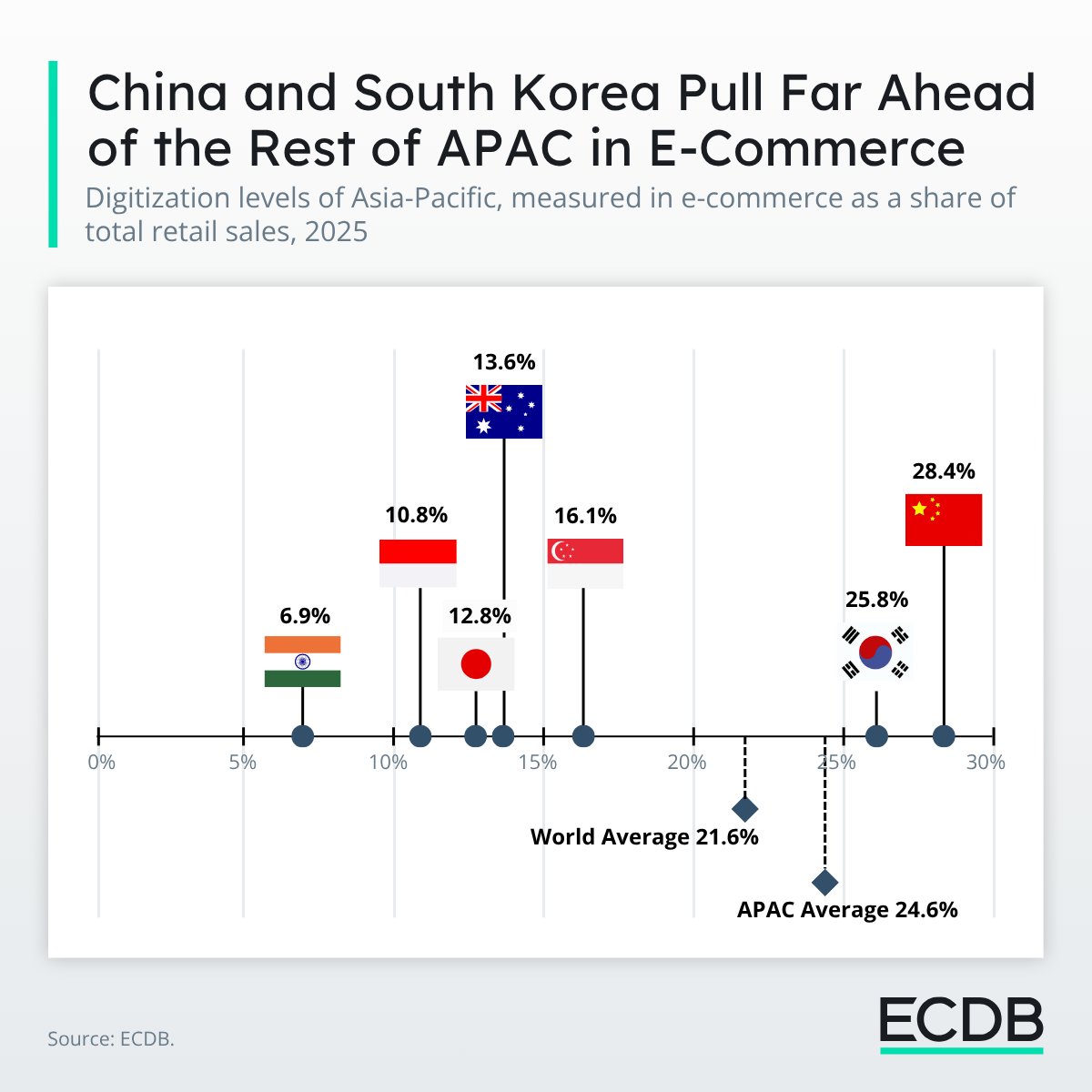
Asia-Pacific is the world's leading region for e-commerce. That distinction primarily comes from China's role. Together with South Korea, China also leads the region's online share. Online share is a measure of digital maturity, measuring how much of total retail revenue moves through online channels.
The world average online penetration rate sits at 21.6%. Thanks to the two leading players, APAC average exceeds that rate with 24.6%. The middle cluster reveals the markets where there is ample room to grow, which contributes to APAC's appeal: peak maturity meets early-stage growth.
Greater China reaches an online share of 28.4%. That figure reflects two decades of platform build-out. Alibaba and JD.com contributed to building China's marketplace infrastructure. Mobile payment is a large contributing factor for China's widespread e-commerce penetration; Shoppers move through app ecosystems that connect everyday services to e-commerce, with payment built into each one.
South Korea follows at 25.8%, running on one of the densest urban populations anywhere. Dense cities, short delivery distances, a logistics network built to match. Coupang shaped shopping habits around that density long before same-day delivery became standard elsewhere.
Both markets reached high penetration through structural advantages that took years to build. Neither is easy for the rest of the region to copy.
Singapore reaches 16.1%, the highest online share in the region outside Greater China and South Korea. Size explains part of that. A population of roughly six million living on about 730 square kilometers makes delivery fast and cheap to operate, and Shopee and Lazada both run their regional headquarters from the city.
High incomes and near-universal smartphone use remove the usual adoption barriers. The same compactness also keeps physical retail within easy reach of almost every household, which caps how far online share can climb.
India and Indonesia carry the region's largest mobile-first populations. Both sit early in their digitization curve, which reflects how much room they still have to grow into.
Indonesia's geography is the constraint. Delivery across an archipelago of thousands of inhabited islands costs more and takes longer than it does on a contiguous land mass, and that cost feeds straight into how much of retail can realistically move online.
India's growth depends on how fast smaller cities come online. Metro demand is established. The next phase of volume sits in tier-2 and tier-3 cities, where payment habits and delivery coverage are still being built out.
The markets outside this chart widen the spread further.
Vietnam, Thailand, Malaysia and the Philippines each run their own version of the mobile-first, marketplace-led pattern that Shopee and Lazada established across Southeast Asia.
Taiwan and New Zealand behave more like the developed middle, with high incomes and retail habits that shifted online gradually.
Further west, Bangladesh and Pakistan sit at the earliest stage of the curve, where payment infrastructure and delivery coverage still determine how much of retail can move online at all.
China carries most of APAC's weight, but these markets are where e-commerce is just picking up pace, in a mobile-first, marketplace-driven environment.
Maturity and potential in the same region is what keeps APAC at the forefront of global e-commerce. The regional average hides that split. Actual opportunity reveals itself where the market-level numbers are.
ECDB not only delivers e-commerce market intelligence on the country level, but across world geographical and political regions. You can view rankings, profiles and compare regions flexibly, all tailored to your specific business needs.

Related Articles
APAC accounts for over 50% of global e-commerce revenues. One of the main drivers is China's leading position, but India and Southeast Asia also have something to do with it.
Seasonality is th predictable rise and fall in demand over the course of a year. ECDB helps prepare for it. Here is how.
High summer brought another e-commerce slowdown, but the year-on-year trajectory points upwards. August revenues reached US$427.9 billion this year, up 7.2%.

Click here for
more relevant insights from
our partner Mastercard.
Book a demo to see how ECDB's market intelligence can support your business.