Just Seven Countries Carry 86% of Amazon's Global GMV
Amazon generated US$847.4 billion in 2025, and 86% of this figure come from only seven markets. Outside that group, even within its own top 10, Amazon's lead already thins.
Retailer Analysis
The marketplace ranks second in France, Spain, Portugal, Greece, Hungary and Romania.

Nadine Koutsou-Wehling
Data Journalist
June 23, 2025
Retailers
Everybody is talking about Temu and its meteoric rise in eCommerce, but what about AliExpress? The international platform of the Chinese eCommerce giant Alibaba has silently climbed to the top rankings of Europe’s online market while everyone else was preoccupied with Temu.
AliExpress has been around much longer than Temu. The marketplace was launched in 2010, while Temu debuted in 2022. However, the rise of one may not be entirely unaccounted for by the success of another. AliExpress’s success in the European market is undeniable, and likely influenced by the breakthrough of others.
AliExpress lingered in obscurity for around a decade before its revenues suddenly spiked in 2023. An overall shift towards low-cost providers of commonly shipped goods from China has likely enabled AliExpress to piggyback off the success of similar platforms.
While retailers like Shein and Temu increased awareness of and trust in the validity of the purchase experience, AliExpress was mostly absent from the discussion. AliExpress's relevance fluctuated during the pandemic, gaining widespread momentum only recently, in 2023.
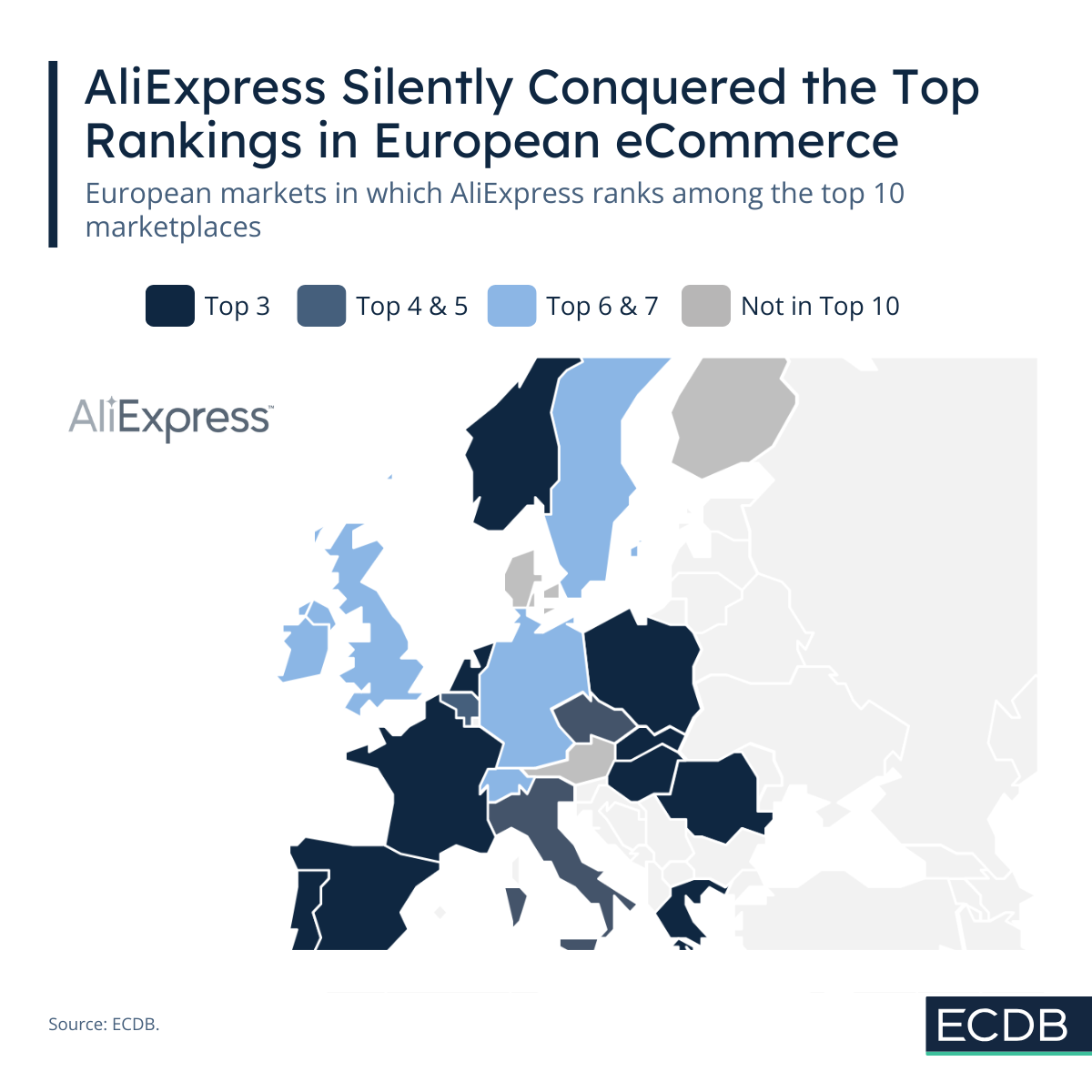
Its prevalence in Europe is especially noteworthy – only a few markets remain in which the marketplace did not reach the top 10 by 2024.
AliExpress has entered the top three marketplaces in an astonishing number of European markets. They include France (where AliExpress ranks second), Spain (2nd), Portugal (2nd), Netherlands (3rd), Norway (3rd), Greece (2nd), Hungary (2nd), Poland (3rd), Romania (2nd) and Slovakia (3rd).
In fact, AliExpress never ranks lower than 7th in any market in which it is within the top 10. Market maturity is not the issue; AliExpress ranks as high in large markets like France as it does in growing markets like Greece or Romania.
Only in Germany, the United Kingdom, Ireland, Switzerland and Sweden does AliExpress rank a little lower, in 6th or 7th place. These markets therefore align with the leading market of the United States, where AliExpress entered the ranking slightly lower.
Exceptions to the widespread rise are Austria, Finland and Denmark where AliExpress is not part of the marketplace ranking.
One of the main reasons for AliExpress’s rise in recent years has certainly been its increased exposure through heightened media coverage. As the saying goes, there's no such thing as bad publicity, and the discussion about low prices has sparked the curiosity of many consumers. While there is a risk of receiving products that fail to meet expectations, more often than not, there is also a bargain to be had.
In addition to offering an endless array of products at low prices, AliExpress is also increasingly popular for dropshipping. In dropshipping, entities (mostly single-person or small businesses) act as distributors of products originating from AliExpress that are forwarded directly to consumers. Distributors take a fee on top of the original selling price. Although it is widely marketed as an easy source of income, it is becoming increasingly competitive and prone to difficulties, such as consumer complaints regarding product quality and shipping time.
AliExpress products are particularly suited to this business model because their prices are lower than those of most other platforms, leaving wide room for profit margins.
Whether for personal consumption or redistribution, AliExpress is growing in relevance. With a few more years and deeper integration with logistics and consumer expectations, the platform could become a real contender with domestic and international eCommerce leaders.

Related Articles
Amazon generated US$847.4 billion in 2025, and 86% of this figure come from only seven markets. Outside that group, even within its own top 10, Amazon's lead already thins.
Sephora is the biggest online beauty retailer by GMV, but that doesn't mean it wins on every other KPI. Here is why it still emerges on top.
Market concentration is a law of retail. On Amazon, this becomes particularly evident. Four in five dollars land in just five countries, the US on top.

Click here for
more relevant insights from
our partner Mastercard.
Book a demo to see how ECDB's market intelligence can support your business.