Cross-Border E-Commerce in Central Europe: Who Sources Most of Their Packages From Abroad?
Not size is the determining factor, but proximity to major e-commerce hubs. That is why certain markets source most of their e-commerce from foreign platforms, while domestic companies fall behind.

Europe is one of the leading cross-border regions worldwide, fueled by the interconnectedness, proximity and infrastructure benefiting exchange. But some markets rely more on outside e-commerce than others. What's most interesting is that size is not the only factor accounting for the differences.
Highest Cross-Border Reliance: From Austria to Hungary
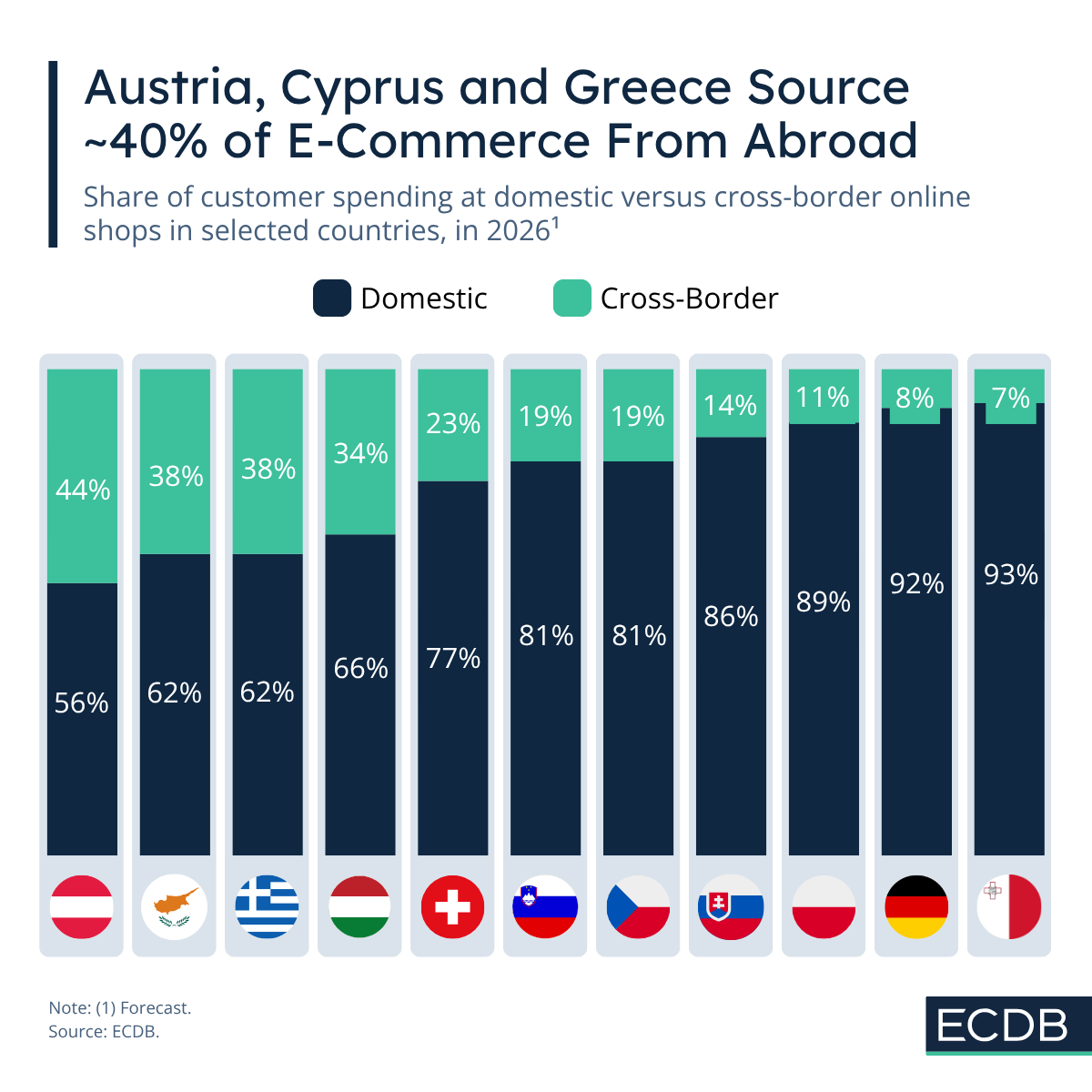
Austria sits at the top of the ten markets tracked, with 44% of its online spending expected to go to cross-border shops in 2026. Cyprus and Greece follow closely behind at 38% each, meaning shoppers in all three countries will send close to two out of every five e-commerce euros outside their own borders.
Hungary is not far behind at 34%. Switzerland rounds out this more import-reliant group at 23%, a figure worth noting given that Switzerland sits outside the EU entirely and still shows meaningful cross-border dependence. Slovenia and the Czech Republic both land at 19%, with Slovakia slightly lower at 14%.
Domestic Focus Most Clear in Malta, Germany and Poland
At the opposite end, Poland, Germany, and Malta keep the vast majority of e-commerce spending domestic. Germany's domestic share reaches 92%, leaving only 8% of spending crossing borders.
Malta edges even higher at 93% domestic share, a striking number for one of the smallest markets in the group. Poland sits close behind at 89% domestic, meaning just over one in ten e-commerce euros leaves the country.
Rather than Size, Proximity to Larger Hub Is a Decisive Factor
Malta's position is the clearest sign that market size alone does not explain cross-border behavior. A small population with limited local retail options might be expected to rely heavily on foreign shops, yet Malta shops almost entirely at home.
Austria shows the opposite pattern. It is a considerably larger and wealthier economy, yet nearly half of its online spending crosses a border. What seems to matter more is proximity to larger retail hubs and how strong domestic platforms are at keeping shoppers close to home.
Proximity and language explain a large part of Austria's number. Austrian shoppers share a language and, for the most part, a retail culture with Germany, Europe's largest e-commerce market. That makes crossing into German storefronts close to frictionless, both linguistically and logistically.
Hungary likely benefits from a similar dynamic, sitting close to Austria and within easy reach of Central European retail hubs that offer more selection than the domestic market alone. Cyprus and Greece point to a different driver: peripheral geography paired with a smaller domestic retail sector. Both are relatively isolated within the EU and have fewer large scale local platforms able to match the range and pricing of retailers based in bigger markets. Where domestic retail cannot cover demand, shoppers fill the gap from abroad, and the EU's single market removes most of the practical friction in doing so.
Related Articles
All ArticlesReady to Unlock the Full Power of ECDB?
Book a demo to see how ECDB's market intelligence can support your business.