High Maturity, Low Growth: Where the Next Growth Hotspots in Central Europe Lie
Central Europe is dominated by one market, but the interesting ones lie on the opposite end of the trend: Where low penetration meets high growth, the next hotspots of e-commerce development arise.

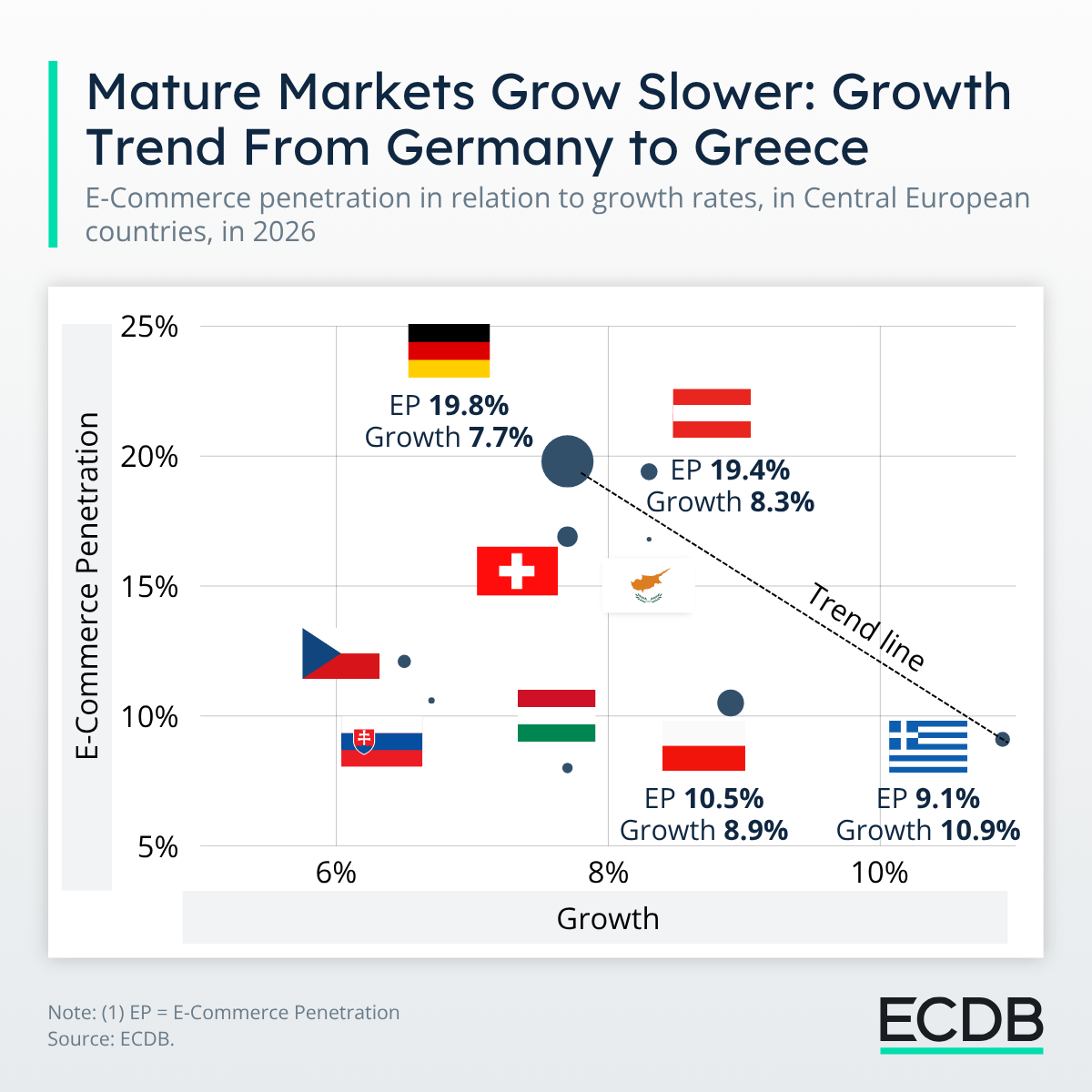
Central Europe's obvious center of gravity lies in Germany. High penetration, stable growth, the largest revenue base in the region. But the market is largely set. Its growth comes from a place of maturity, while other markets are emerging from a much earlier stage.
The more interesting story sits elsewhere, at the point where high growth meets moderate penetration. That is where Greece, Poland, and Hungary come in. Together, they mark the point where the DACH success story ends and a new one begins.
Germany Represents One End of the Spectrum: High Maturity and Slower Growth
Germany remains the single largest contributor to Central European e-commerce revenue in absolute terms. That is unlikely to change soon. Forecast revenues of €118.7 billion in 2026 put Germany at more than 57% of the region's total. No other market comes close.
Germany is the home market for some of the most ambitious cross-border retailers in Europe, including Otto, Zalando, About You, Kaufland, and MediaMarkt. These platforms expanded well beyond their domestic base, and their growth has shaped how e-commerce developed across neighboring markets, particularly within the DACH/GSA cluster.
But high penetration leaves less room to grow into. Germany's e-commerce future is a maturity story, not a growth story. The next phase of e-commerce growth in Central Europe is written elsewhere.
Greece, Poland and Hungary Are Where the Growth Sits
Three markets stand out for the opposite reason. Their online share is still moderate, and their growth rates are high enough to close that gap.
Greece is worth $9.7 billion and growing at 10.9%, with an online share of just 9.1%.
Poland, the region's fourth-largest market at $31.2 billion, is growing at 8.9% with penetration at 10.5%.
Hungary is smaller still, at $4.7 billion, growing at 7.7% with an 8% online share.
Greece sits on the periphery of the EU, and its domestic retail sector has never scaled to match the range or pricing of bigger platforms elsewhere in Europe. That structural fact is also why Greek shoppers already send a high share of their online spending abroad, and it points to plenty of runway left for domestic e-commerce to grow into.
Poland's size sets it apart from the other two. It is large enough to support a domestic platform ecosystem of its own, most visibly through Allegro, one of the region's biggest homegrown marketplaces. That scale also makes Poland a credible entry point for retailers looking to expand further east.
Hungary sits right at the edge of this high-growth, low-penetration cluster. It shares more in common with Slovakia and the Czech Republic than with Poland in terms of market size, but its growth rate places it near high-growth markets Greece and Poland.
Austria and Switzerland Show What Comes Next
Austria and Switzerland tell a different story. Both are already highly mature markets. Their proximity to Germany, and the infrastructure that comes with it, has pushed them further along the maturity curve than their domestic markets alone would explain.
Slovakia and Slovenia Sit Further Out
Slovakia and Slovenia round out the picture. Both are small markets with moderate penetration. Growth is slower, at 6.7% and 4.4% respectively.
Population size is one reason. Slovakia counts roughly 5.5 million people and Slovenia around 2.1 million, a fraction of Poland's base and well below Greece and Hungary as well. A smaller pool of potential online shoppers limits how fast a market can expand in percentage terms.
Slovenia's slower growth also reflects where it already stands. Its online share is projected to edge ahead of Poland, Greece, and Hungary by 2026, leaving less room left to grow into. Slovenia is not behind the high-growth cluster so much as further along the same curve.
Cross-border demand plays a role too. Slovenia sources roughly a quarter of its online spending from foreign retailers, and Slovakia close to a fifth. In both markets, part of the growth that might otherwise build up the domestic market instead flows abroad.
Slovakia's online share sits closer to the high-growth cluster than Slovenia's, so its slower pace looks less like a lack of headroom and more a function of its small market size and cross-border reliance.
Wrap-Up: Movement Along the Trend Line
Mapping out these different markets leads to a spectrum: Markets with low penetration tend to grow fast. Markets with high penetration tend to grow slowly. Germany sits at one end of that line. Greece, Poland, and Hungary sit further down it, still with plenty of distance left to travel.
If that trajectory holds, Central Europe's e-commerce landscape stops looking like one dominant market surrounded by smaller ones, and starts looking like a cluster. A group of markets converging toward similar penetration levels, each having taken a different route to get there. The DACH/GSA cluster was the first version of this pattern. Greece, Poland, and Hungary look like the next.
Related Articles
All ArticlesReady to Unlock the Full Power of ECDB?
Book a demo to see how ECDB's market intelligence can support your business.