E-Commerce Localization: Definition & Best Practices
E-Commerce localization means adapting a store for a specific market, currency, payment method, cultural norms and more. Here is how to leverage it in e-commerce.

Article in a Nutshell:
Localization means adapting a store for a specific market, currency, payment methods, cultural norms, and local shopping habits, not just translating the language on the page.
Localization matters specifically in an internationalized market: Cross-border e-commerce is becoming more prevalent all around the world.
Payment methods are the clearest example of how differently this needs to be handled market by market. They vary widely across countries and are therefore a hallmark of localization practices.
E-Commerce localization is the practice of adapting a store, not just translating it, for a specific market: language, currency, payment methods, cultural expectations, and the norms shoppers in that country already carry into a purchase.
Translation is the easy 10% of the job. Everything past that is what actually decides whether a localized market performs like a local competitor or still feels like a foreign site with different words on it.
Why Localization Matters
Cross-border shopping is already the norm for a meaningful share of the world's e-commerce, not a fringe behavior. Austria sources 40% of its e-commerce from abroad, Belgium 24%, Switzerland 19%, while larger markets like Germany, the UK, and the US stay under 10%.
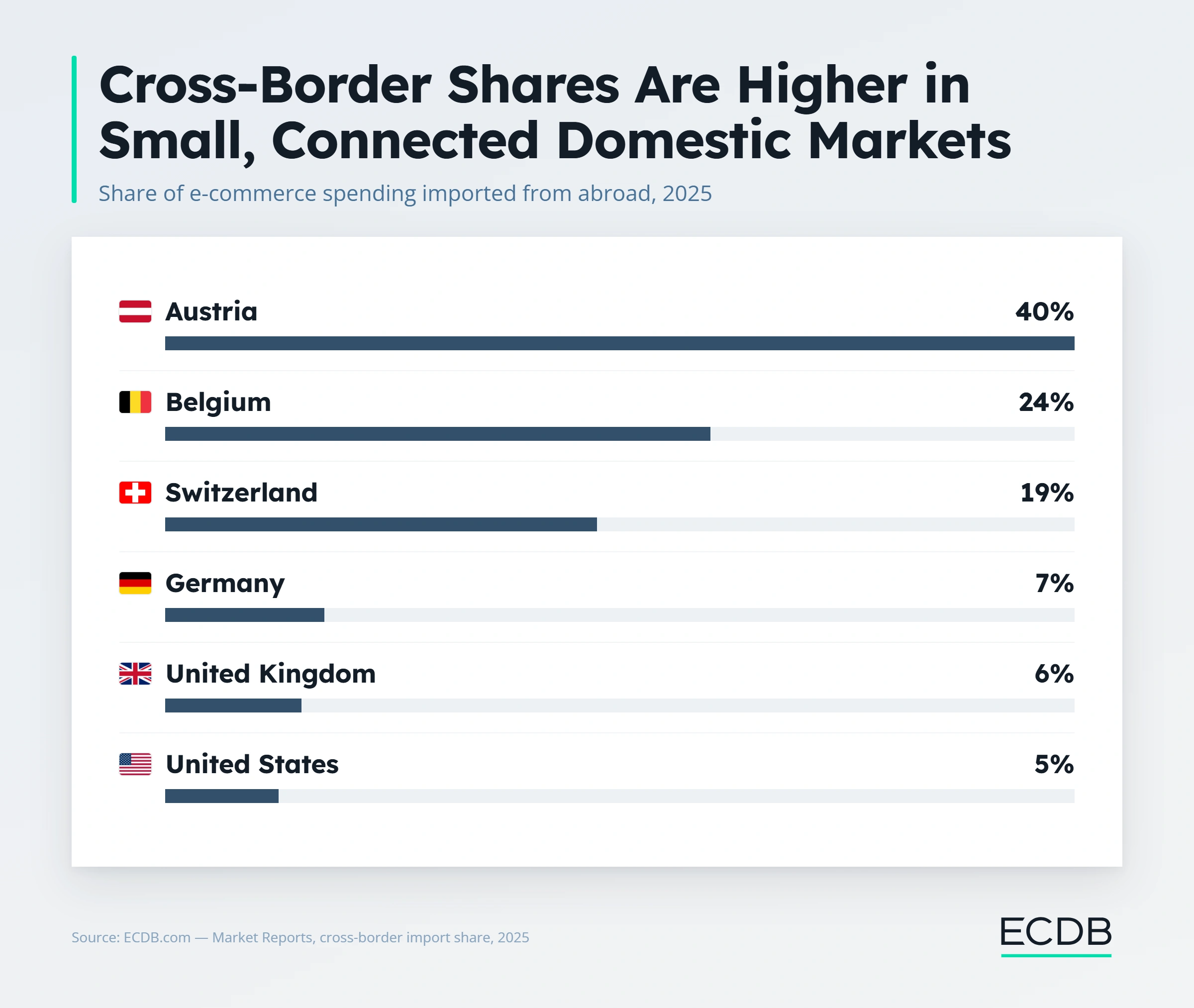
That gap says something important: shoppers in smaller markets are already comfortable buying from a store based somewhere else, provided that store gives them a reason to trust it. Localization is usually that reason.
A shopper crossing a border to buy something is far more willing to do it when the price is in their own currency, the support team can be reached in their own language, and the payment method on offer is one they actually use.
What Localization Actually Requires, Beyond Translation
Payment methods are the clearest example of how differently this needs to be handled market by market. Douglas.de, a German retailer, offers its customers the option to pay by invoice, order first, pay after the item arrives, a payment method that remains genuinely popular in Germany and would strike shoppers in most other countries as an unusual way to buy something online.
Amazon, meanwhile, offers a completely different payment mix depending on the market: two options in the US, eleven in the UK, and a different combination again in Canada. Even a retailer with Amazon's resources treats payment localization as market-specific rather than assuming one global setup will do.
Returns need the same market-by-market thinking, because the same policy doesn't cost the same everywhere. Apparel gets returned at 31.18% in the US, against 23.75% in Germany and 23.77% in the UK.
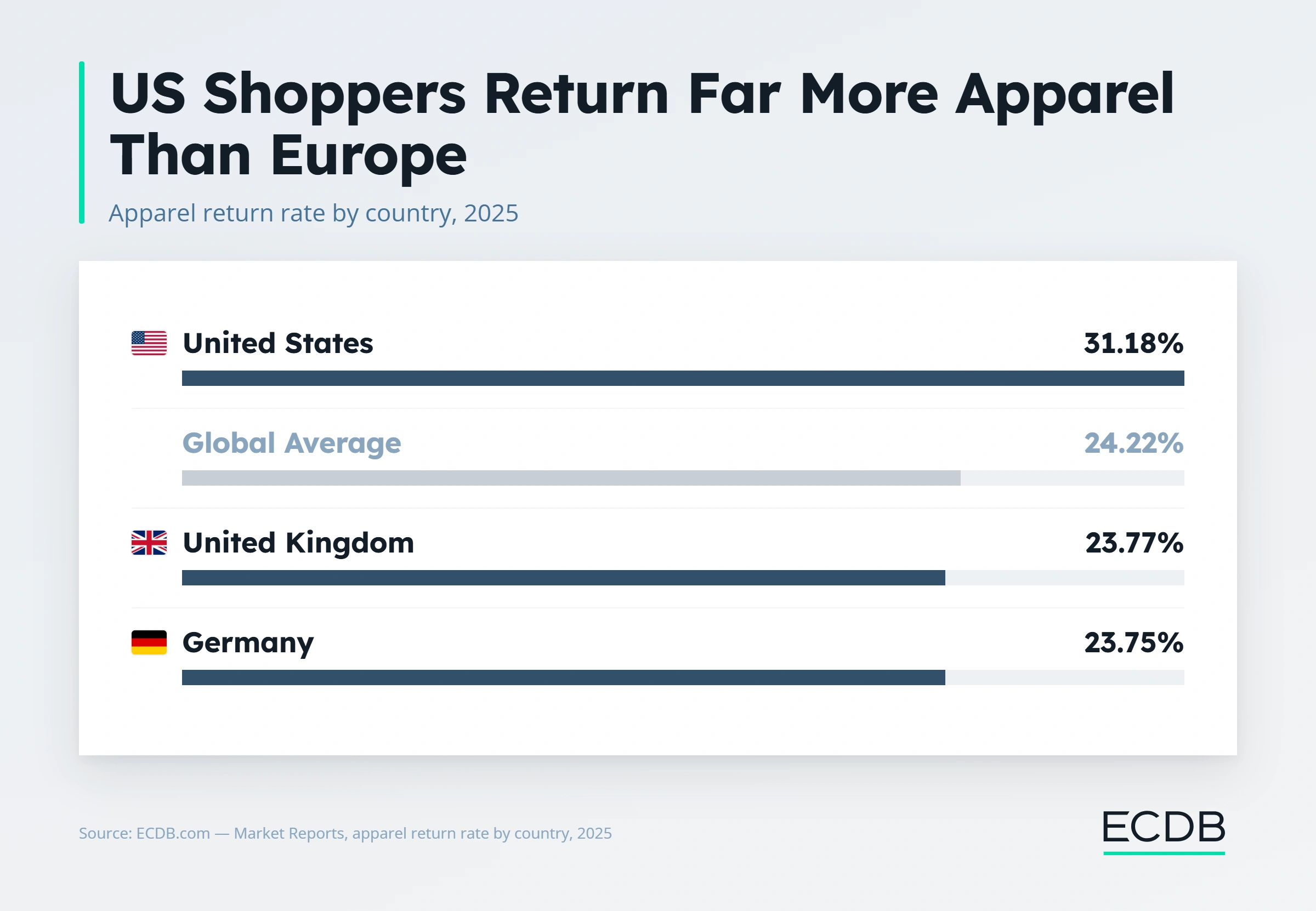
A generous, free-return policy that works fine in one market can become a much bigger cost center in another, not because the product changed, but because local shopping norms around returns did.
Best Practices for E-Commerce Localization
A handful of practices consistently separate a localized store from a translated one:
Price and display everything in the local currency, and round prices the way local shoppers expect, rather than a direct currency conversion that lands on an unfamiliar number.
Offer the payment methods that are actually standard in that market, not just the ones that work well at home, since a missing local payment option is often where a checkout loses a sale without anyone noticing why.
Set a return policy calibrated to local return behavior, generous enough to convert, without importing a cost structure built for a market that returns very differently.
Adapt imagery, sizing, and product descriptions to local norms, since a size chart, a unit of measurement, or a lifestyle image that doesn't match local expectations creates the same hesitation a wrong price would.
Handle local tax, VAT, and compliance requirements explicitly at checkout, since an unexpected charge added at the final step erodes trust fast, however well everything before it was localized.
Track performance market by market rather than as one global average, since a single blended conversion or return rate can hide a specific market that's underperforming for a specific, fixable reason.
None of these practices work as a one-time setup. A market's payment habits, return behavior, and price sensitivity shift over time, and a localization strategy needs the same ongoing check any other part of a growth strategy does.
How ECDB Helps You Localize With Real Data
You don't have to guess which payment methods, return norms, or price points fit a given market. ECDB tracks payment providers, return rates, AOV, and cross-border share by country and category. These are the exact signals that separate a market where a generic global setup will hold up from one where it won't.
That data is available through ECDB's Profiles and Analyze & Compare tools, so a localization strategy can be built around what a specific market actually expects, rather than a translated version of what worked at home.

Related Articles
All ArticlesReady to Unlock the Full Power of ECDB?
Book a demo to see how ECDB's market intelligence can support your business.