Amazon’s Edge in the US: Online Shoppers Order 22 Times a Year
Amazon not only beats its competitors in revenue, but races ahead when it comes to purchase frequency as well: Customers order roughly every 17 days on amazon.com. Other retailers in the comparison fall behind.

Nadine Koutsou-Wehling
Data Journalist
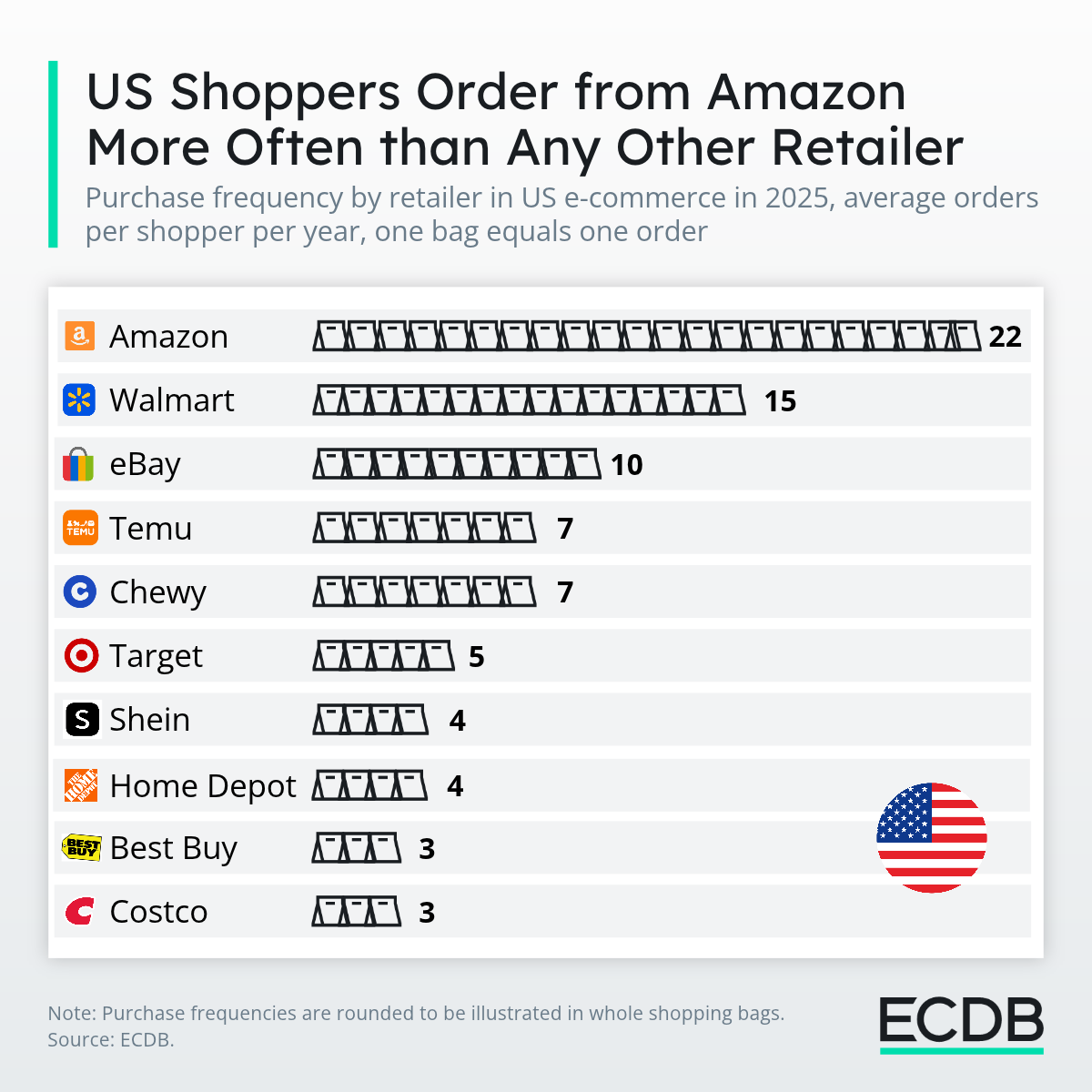
Amazon leads the US e-commerce retailer ranking by revenue, and also by purchase frequency. That is because for its customers, Amazon is a one-stop shop, and the frequency of its customers' ordering habits cements Amazon's market leadership.
The average amazon.com customer orders 22 times a year. No other retailer in the US comparison comes close.
Walmart Comes Closest, Seven Orders Behind Amazon
From the US top 20 retailer ranking, we selected 9 large US stores that compete with Amazon across categories. Some of them are generalists (like Walmart, eBay, Temu, Target and Costco), while others are specialists (such as Chewy, Home Depot, Best Buy and Shein). Fact is, customers of all of these stores are expected to buy at Amazon as well. And they likely do, given Amazon's outstanding position in the market, not in the least represented by its annual purchase frequency.
At the amazon.com domain, customers purchase on average 22 times a year. This means that an average customer orders roughly every 2 weeks (i.e. 17 days) at amazon.com.
Walmart sits on the second spot for a reason. The hypermarket chain follows at a considerable purchase frequency of 14.8, rounded to 15 times a year for our depiction. The lower half of the ranking shows how exceptional 22 orders a year are. eBay, in third place, reaches less than half of Amazon's figure. Target customers order five times a year. Best Buy and Costco customers order three times, about once every four months.
Purchase Frequency Is One of Several Revenue Drivers
A retailer's revenue depends on how often customers order, how much they spend per order, and how many customers it has. Purchase frequency covers the first factor. AOV and the number of buyers shape the other two.
Costco shows how the factors interact. Its customers order online only three times a year, and they buy in bulk. Best Buy works in a similar way, with consumer electronics as considered, higher-ticket purchases that shoppers make a few times a year.
Amazon's advantage in purchase frequency carries weight. Every additional order is another moment where a customer chooses Amazon over a competitor. Over a year, those moments add up to 22 decisions in Amazon's favor.
Prime and Fast Delivery Turn Orders Into Habit
Force of habit is powerful. Amazon pulls orders away from generalists and specialist retailers alike, and its perks make that pull hard to resist.
Amazon Prime is the anchor. Members pay a subscription fee and receive free shipping on eligible orders, which lowers the threshold for every further purchase. Same-day and next-day delivery remove the last reason to wait. A shopper who needs batteries, dog food, or a phone charger can order all three in one session and have them at the door within a day.
This convenience extends Amazon's reach into categories with dedicated specialists. Chewy's customers order pet supplies seven times a year. Home Depot's customers buy home improvement goods four times. Amazon competes in both categories and offers the same products in a checkout its customers already use about every 17 days.
Wrap-Up: The One-Stop Shop Takes Away From Other Retailers
Amazon holds a regular place in the everyday decisions of US shoppers, and that place turns single purchases into a steady flow of repeat orders. At the same time, this means that the decision to buy at amazon.com takes away from other retailers, who offer similar products and may have their own set of perks available. But force of habit is powerful, and same-day to next-day delivery hard to beat. Walmart comes closest with 15 orders a year. Every other retailer in the ranking reaches ten or fewer. For now, the habit of ordering on Amazon is one of its most durable advantages.

Related Articles
All ArticlesReady to Unlock the Full Power of ECDB?
Book a demo to see how ECDB's market intelligence can support your business.