This Is How the EU's Customs Changes Affect Temu and Amazon
One wins, the other loses. Business model makes all the difference when it comes to customs regulations. The new customs change, following the abolishment of de minimis, has a clear effect.

Nadine Koutsou-Wehling
Data Journalist
Article in a Nutshell:
Since July 1, 2026, the EU has charged a €3 customs duty per product group on parcels below €150 from third countries. Since November 1, a €2 handling fee per parcel has applied on top.
The combined transaction share of Temu, Shein and AliExpress among the EU’s top 100 retailers fell by 11 percentage points. In the UK, where no such duty applies, it stayed flat.
Temu was hit hardest, with its share halving from 16% to 8%. Shein fell from 5% to 3% and AliExpress from 2% to 1%.
Shoppers who still order spend more per purchase. AOV rose by 37% at Temu, 14% at Shein and 1% at AliExpress.
Amazon, Zalando and Vinted picked up 9.4 of the 11 lost percentage points.
Local fulfillment, already used in the US, could soon let the three retailers sidestep the duty in the EU as well.
Since July 1, 2026, a new €3 customs duty applies to parcels below €150 entering the EU from third countries. Previous ECDB articles already showed who it targets: Chinese retailers, above all the fast risers Temu, Shein and AliExpress.
A €5 phone case from Temu now arrives with a €3 duty on top. The duty is charged per product group, so a pair of trousers in the same parcel adds another €3.
On top of that, on November 1, 2026, an additional fee took effect: an EU-wide handling fee of €2 per parcel. The fee covers the cost of customs checks on the growing flow of small shipments. The transaction data in this article predates it.
Several months in, ECDB’s transaction data shows a clear change in customer behavior. Shoppers buy less often, but they buy more each time they order. Here is what the new duty has changed so far.
Transaction Share Shrinks for Temu, Shein and AliExpress
EU shoppers have bought less often at Temu, Shein and AliExpress since the duty took effect. Among the EU's top 100 retailers, the three platforms' combined share of transactions shrank by 11 percentage points.
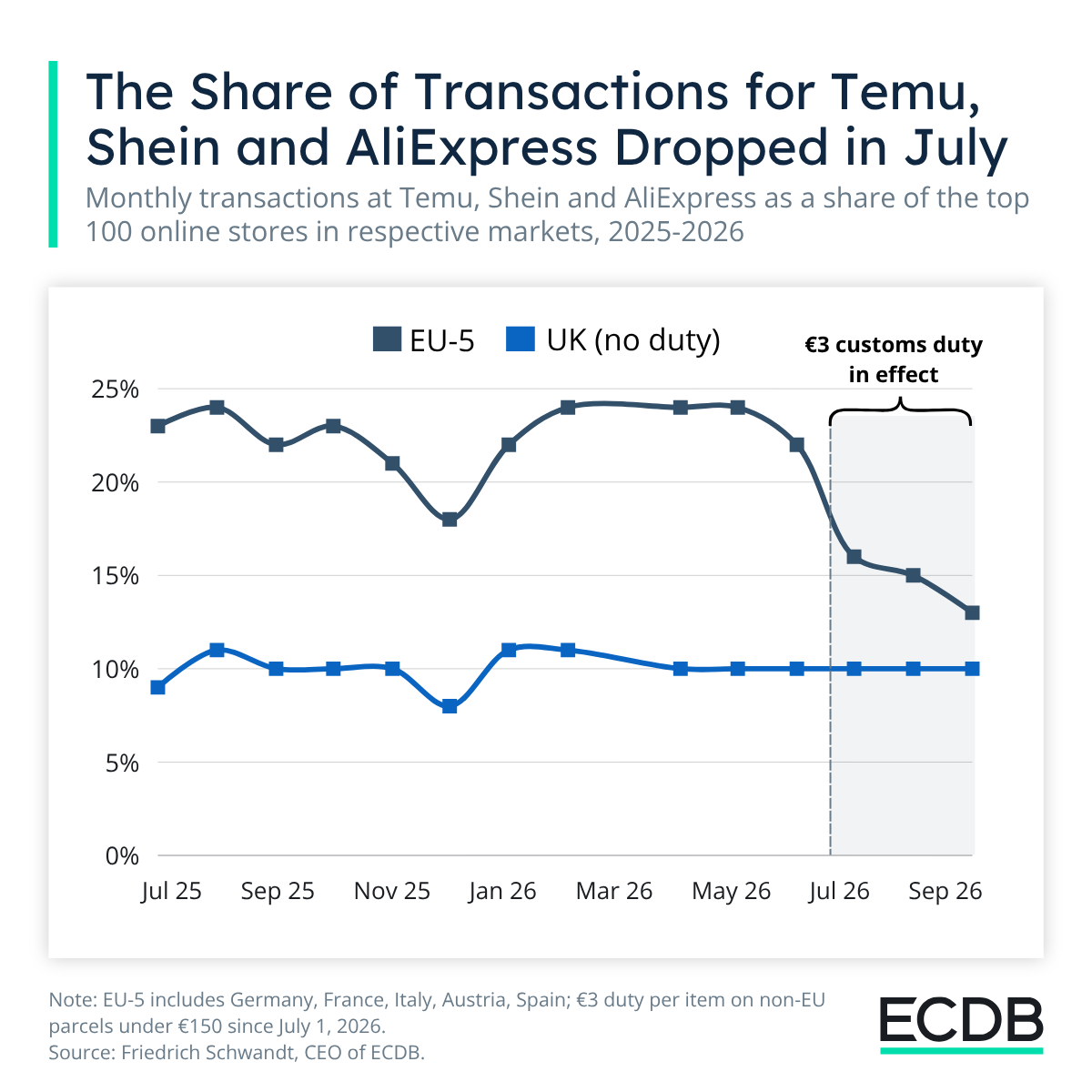
The UK offers a useful comparison. No such duty applies there, and the three retailers' share stayed flat over the same period. Same platforms, same assortment, same months. The duty is the variable that changed.
Frequent small orders were the core of the business. A shopper who used to place three or four €10 orders now pays €3 per product group. Many of those orders simply stopped. The new rule aims to protect European retailers from low-price competitors. A flat €3 fee hits cheap items hardest. On a €50 order it adds 6%. On a €5 phone case, it adds 60%.
Temu Shoppers Put More into Each Basket
Average order value at Temu rose by 37% in the EU. Shoppers who still order now put more into each purchase. The duty is charged per product group, and it hurts cheap orders the most. Low-value orders became the least worth placing, so they are the ones that dropped away.
The orders that remain skew toward higher values, which lifts the average. Shoppers also have a reason to stock up within a product group: five phone cases in one parcel carry the same €3 as one.
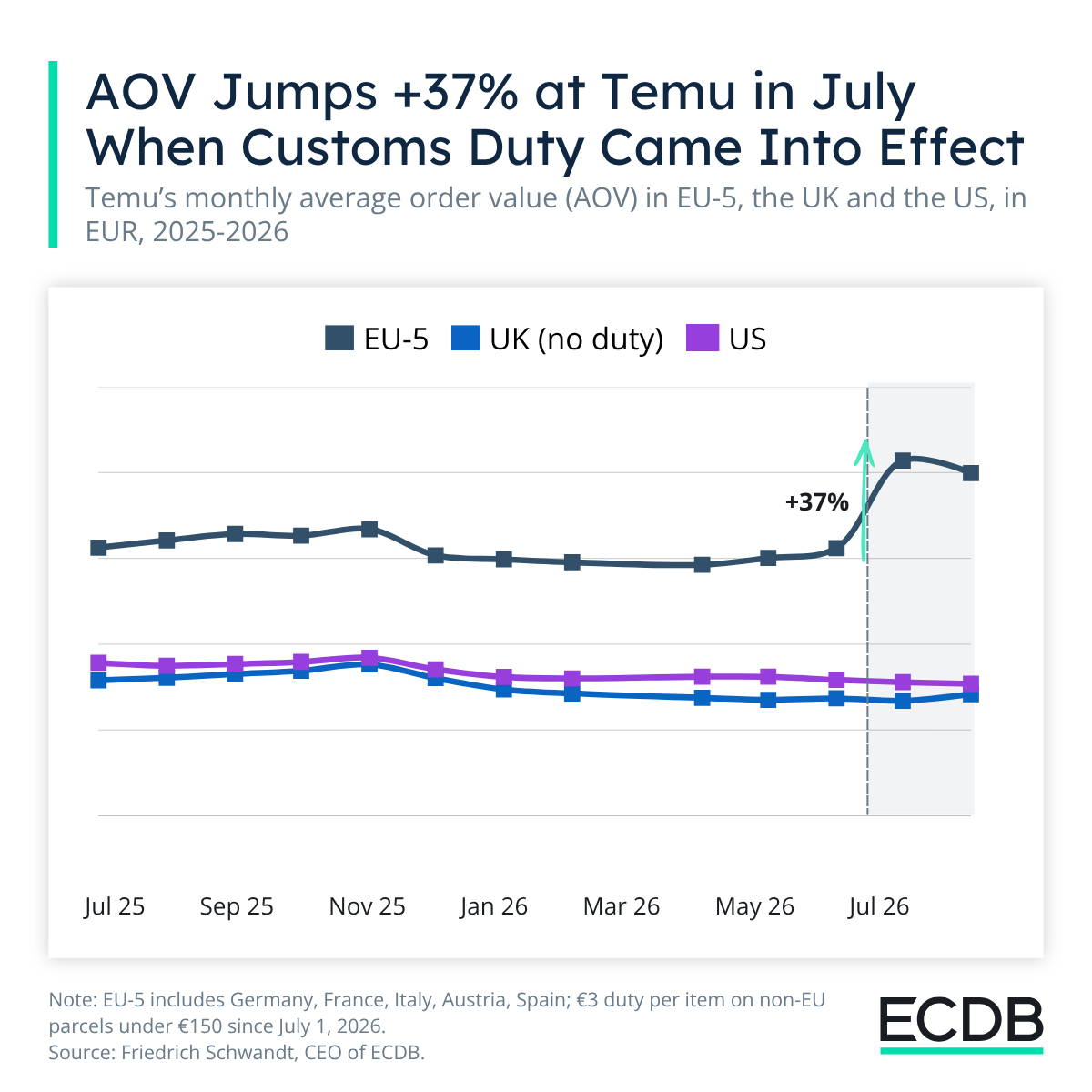
Outside the EU, the picture stayed calm. In the UK and US, Temu relies on local fulfillment, shipping from warehouses inside the market. AOV held steady in both. Without the duty, shoppers had no reason to change their habits.
The US model is likely where the EU is headed next. With local fulfillment, goods arrive in bulk at EU warehouses and reach shoppers as domestic deliveries. The €3 duty on small parcels no longer applies, and prices can stay low. However, the switch calls for heavy investment and regional partnerships. The retailers have reportedly been building both for months.
Temu Has Been Hit Hardest; Shein and AliExpress Follow
Overall, Temu has been the most affected. Its share of transactions was largest of the three retailers, at 16%, which declined to half, at 8%.
Shein had a transaction share of 5%, which declined by 2 percentage points to 3%,
AliExpress had least influence at 2% and the smallest decline of 1 percentage point.
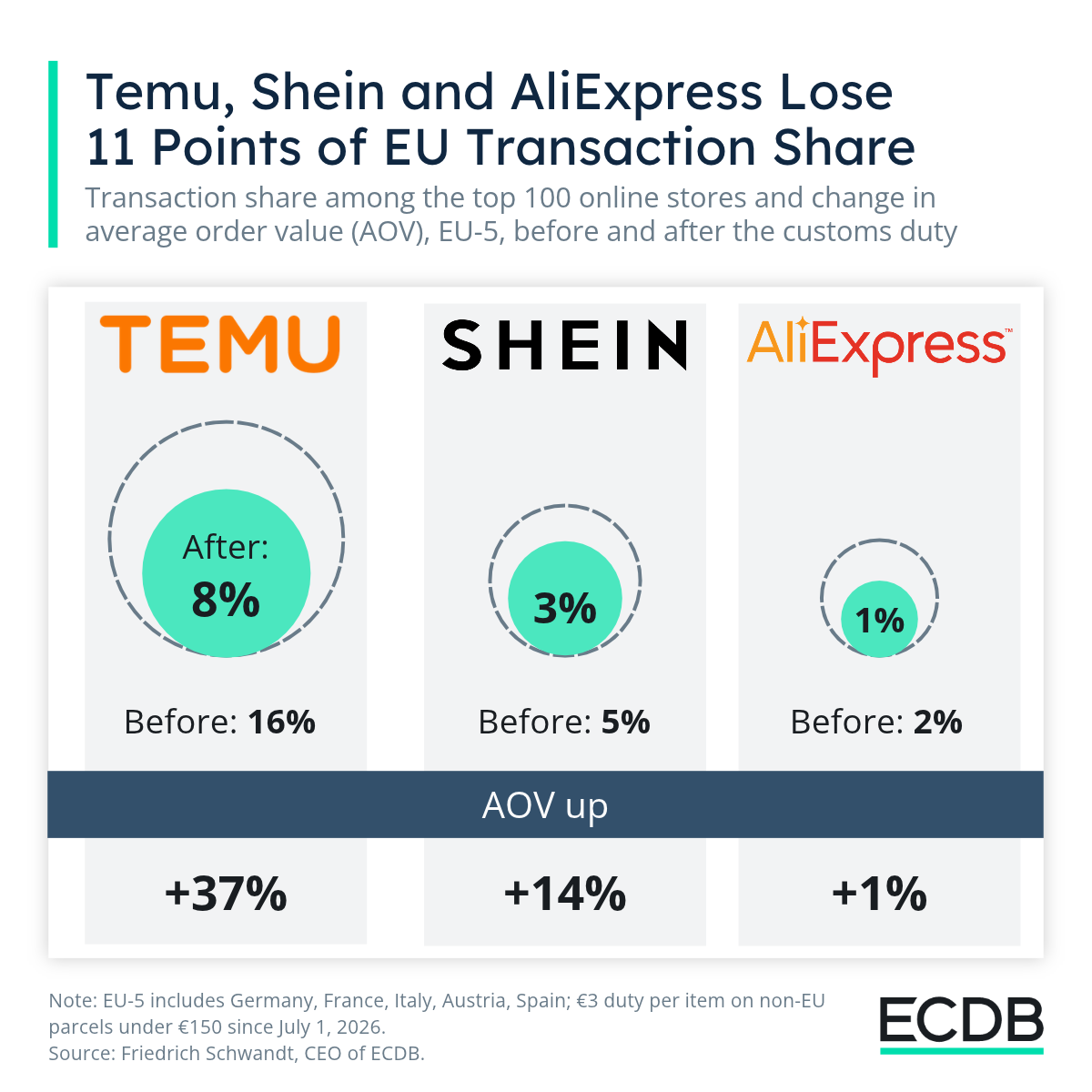
The AOV increases follow the same order. Temu shoppers raised their order values the most, Shein lands in the middle, and AliExpress shoppers barely changed how much they spend per order.
The gap comes down to price points. Temu’s catalog is built on single-digit prices, where a €3 duty can add half the item’s value or more. Many of those orders stopped, and the ones that remained grew larger. Shein sells fashion at somewhat higher prices per item, so the duty takes a smaller bite. AliExpress already ships part of its European orders from local warehouses, which shields those orders from the duty and explains why its AOV barely moved.
The Winners of the Regulation: Amazon and Fashion
Where some lose, others win. Amazon and the leading fashion platforms Zalando and Vinted picked up most of the lost ground. Together, they gained 9.4 of the 11 percentage points that Temu, Shein and AliExpress gave up. The remaining 1.6 points spread across the rest of the EU’s top 100.
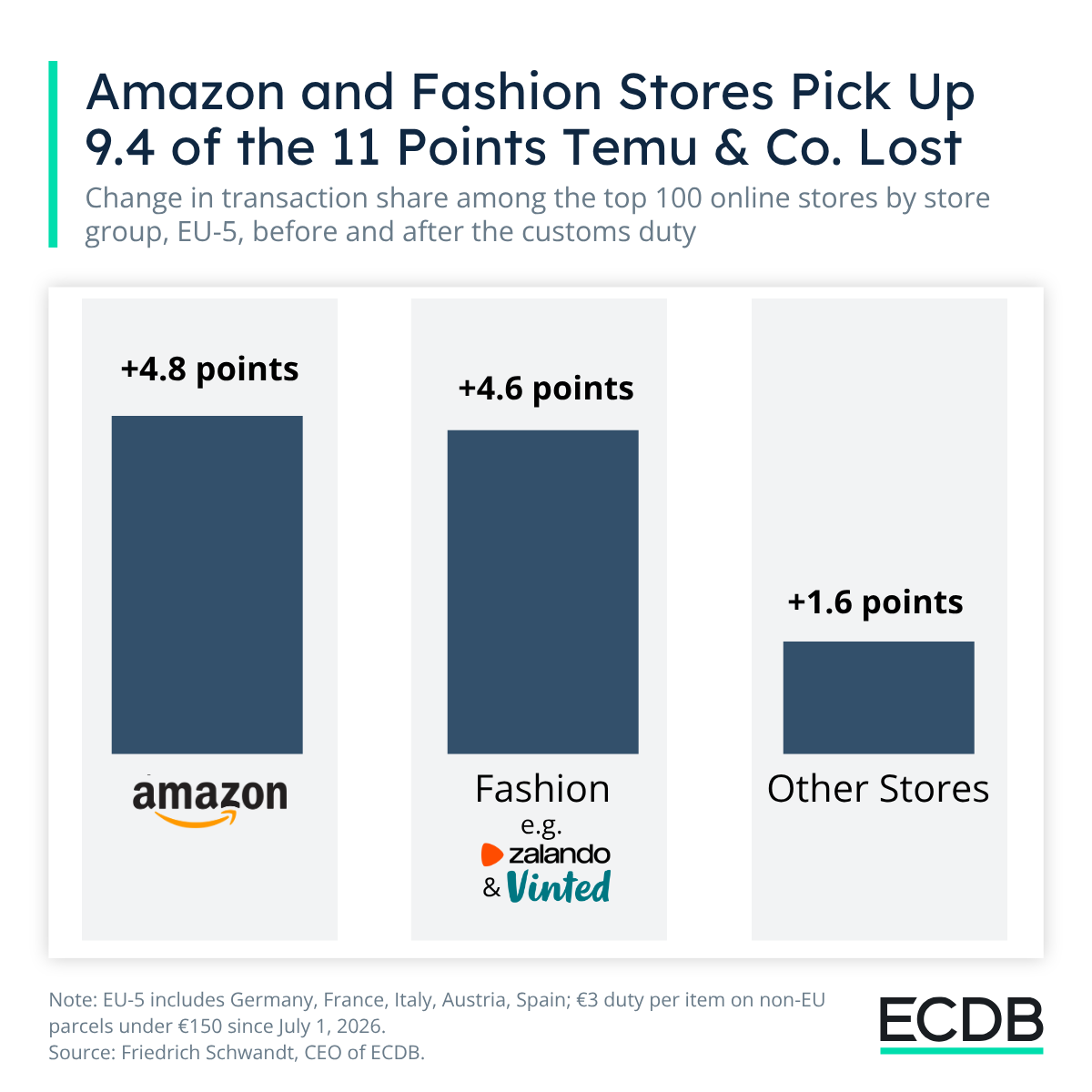
All three winners deliver from inside the EU. Amazon ships from its European fulfillment network, so its orders carry no customs duty and often arrive within a day or two. For shoppers who used Temu for cheap household items and gadgets, it is the closest alternative with a broad catalog.
Zalando and Vinted cover the other half of the gap, fashion. Zalando offers a wide branded range with free returns, which appeals to Shein shoppers who move up a price tier. Vinted serves the shoppers who stay price-sensitive. Secondhand pieces from other EU users often cost as little as a new Shein item, and they arrive without a duty on top.
Wrap-Up: Tax Effects Are Immediate, but How Long They Last Is Uncertain
The new customs duty from July 1, 2026, has had a clear effect on Temu, Shein and AliExpress. Shoppers buy from these retailers less often, but when they do, they spend more per order. Temu, with the lowest price points, felt it most. Amazon, Zalando and Vinted picked up most of the lost transactions.
These effects have held for several months and will likely deepen with the €2 handling fee charged per parcel since November 1, 2026. Still, we expect the long-term effect to fade. In the US, Temu, Shein and AliExpress have already shown how local fulfillment works around such rules. Once their goods arrive in bulk at EU warehouses, the small-parcel duty no longer applies, and the price disadvantage it created goes with it.
The coming months will show how fast that shift happens. EU warehouse openings and regional partnerships are the signals to watch. Until then, the duty keeps cheap parcels at the border, and the winners hold on to the transactions they gained.

Related Articles
All ArticlesReady to Unlock the Full Power of ECDB?
Book a demo to see how ECDB's market intelligence can support your business.