Fashion Drives Almost Half of EU Online Spending at Third-Country Retailers
Fashion’s importance as an e-commerce category rises in cross-border purchases. Almost half of the EU’s third-country cross-border spend goes to fashion. Here is why.

European online shoppers regularly order from retailers outside the EU. What they buy there looks very different from what fills their baskets at home. One category dominates those purchases, and the reasons say a lot about how cross-border e-commerce works.
Fashion Takes Almost Half of Third-Country Spending
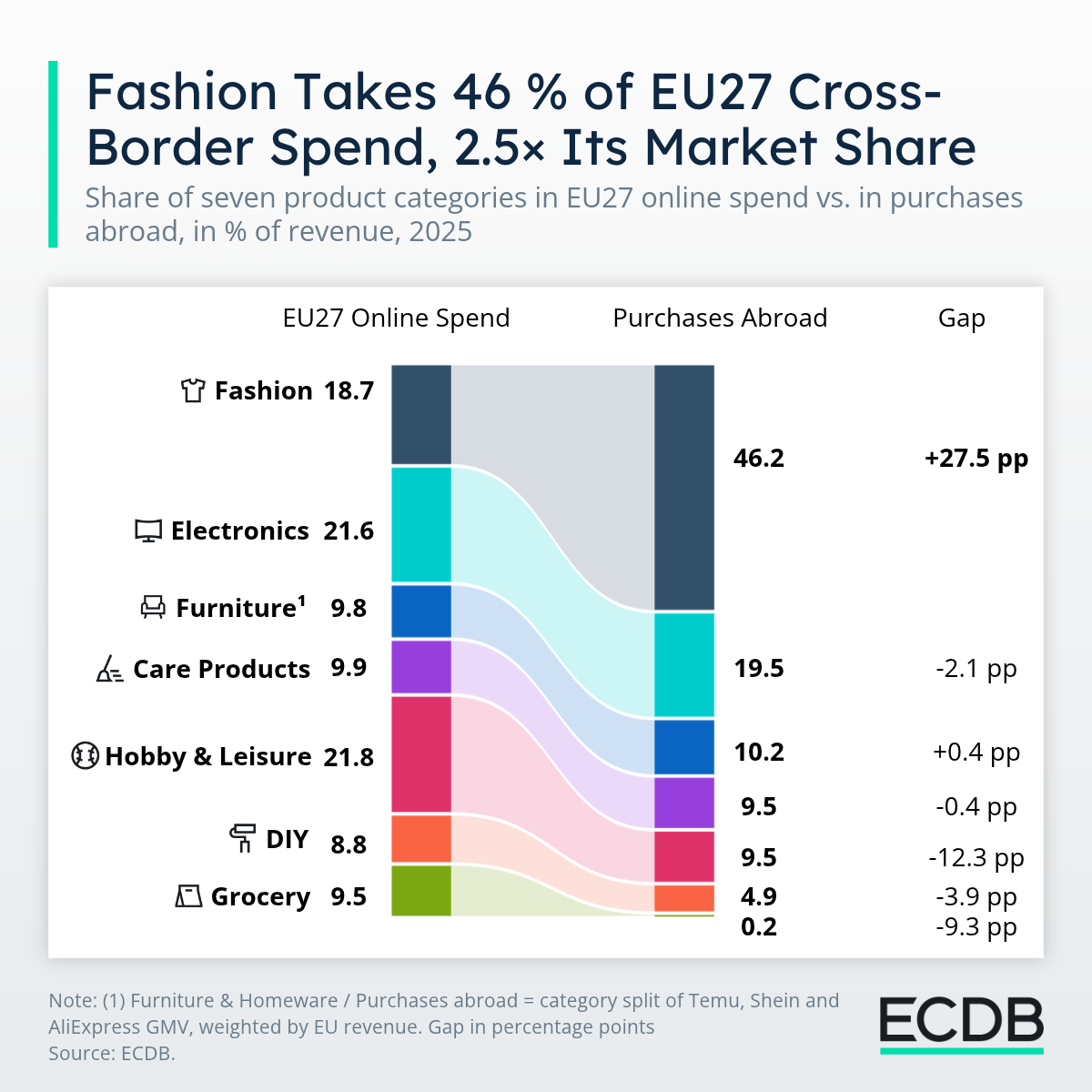
Fashion accounts for 46.2% of the revenue EU-27 shoppers spend at retailers in third countries. Across all online spending in the EU-27, the category holds just 18.7%. Its weight in cross-border purchases is roughly two and a half times its weight in the overall market.
The platforms behind cross-border demand explain that gap. Shein is primarily an apparel retailer. Temu, AliExpress and similar marketplaces cover far broader assortments, yet clothing and accessories make up a large part of what they sell. When the biggest third-country players are fashion-first, the category mix of cross-border spending follows them.
Clothing Travels Well Across Borders
The product itself fits long-distance delivery. Clothing is light, compact and unbreakable. A T-shirt folds into a small polybag and survives rough handling. Shipping costs per item stay low, and parcels move easily through postal and courier networks.
Few other categories travel this well. Furniture is bulky and expensive to ship. Groceries spoil. Electronics raise questions about warranties, plug types and EU compliance. Each of these adds cost or risk to an order placed thousands of kilometers away, and fashion carries almost none of it.
Electronics Ranks Second Despite the Hurdles
Electronics still comes in as the second-largest cross-border category. Price is the reason. Cross-border leaders offer affordable alternatives to costly branded devices. That price gap is one of their main competitive advantages.
For many consumers, the savings outweigh the doubts. Safety concerns and compliance questions remain, but a much lower price tag is often enough to set them aside.
The Rest of the Basket Thins Out Quickly
After Fashion and Electronics, no other category reaches more than about a tenth of cross-border spending.
Furniture & Homeware capture 10.2% of cross-border spend
Care Products are at 9.5%
Hobby & Leisure likewise with 9.5%
DIY accounts for 4.9%
Grocery only 0.2%
It is clear why Grocery comes in last. Food spoils, and shoppers trust their local supermarket far more than a foreign merchant for it.
Wrap-Up: Light, Cheap and Durable Goods Cross Borders Best
The category ranking follows a clear logic. Products that ship cheaply, survive the journey and sit at the core of the leading platforms' assortments dominate cross-border spending. Fashion checks every box. Grocery checks none.
That makes the pressure uneven across European retail. Grocers face little competition from third countries. Electronics retailers compete on price against cheaper unbranded alternatives. European fashion retailers carry the heaviest load, with competition sitting as much in Shenzhen as on the local high street.
Related Articles
All ArticlesReady to Unlock the Full Power of ECDB?
Book a demo to see how ECDB's market intelligence can support your business.