Germany Accounts for Over Half of All Central European E-Commerce Revenues
Central Europe is dominated by one market in particular. Here is how the others are holding up.

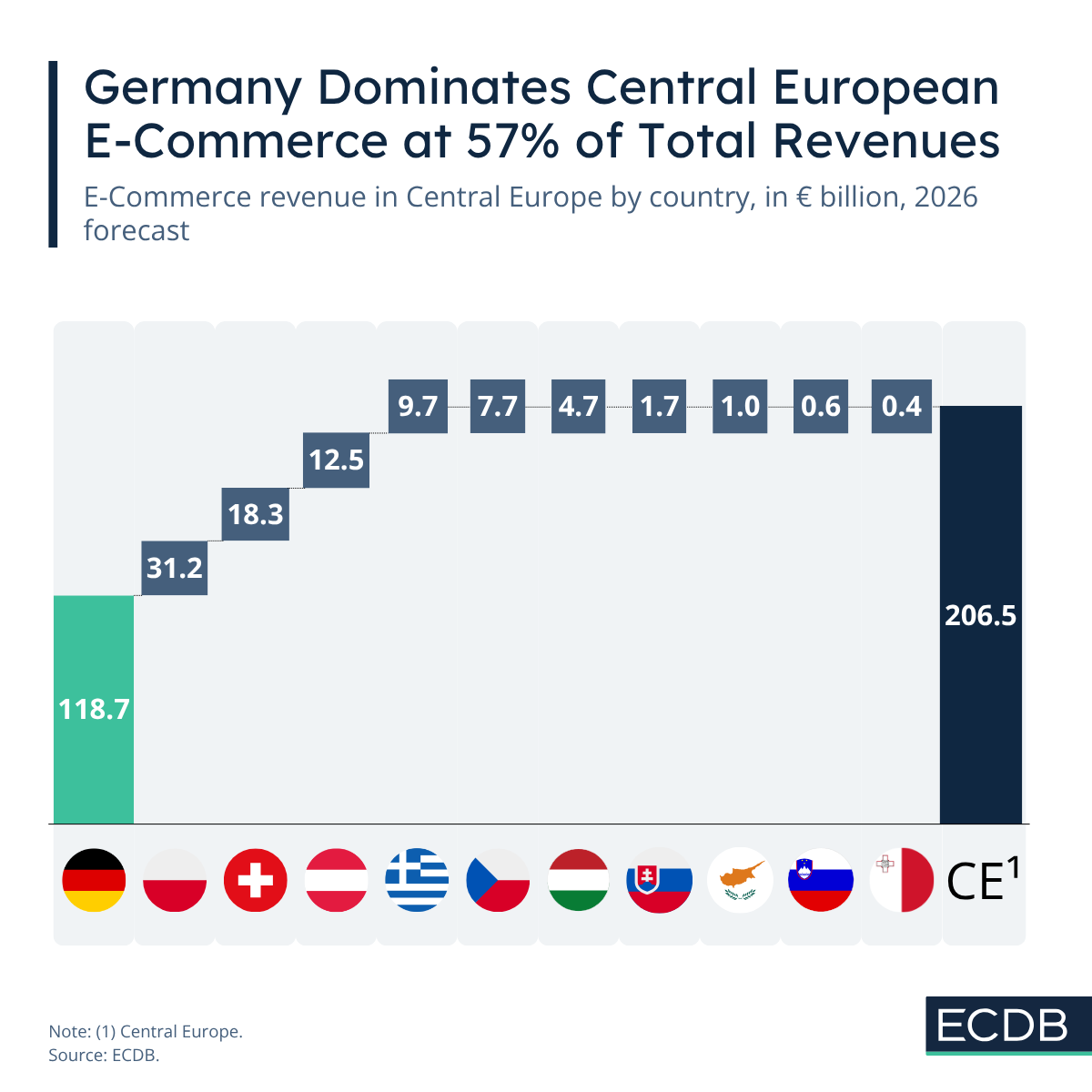
Central Europe generates €206.5 billion in total e-commerce revenues. A large share of that is concentrated in one market: Germany. The remaining markets follow at a considerable distance. Below is a breakdown of the forces shaping that distribution.
Germany Sets the Tone
With forecast figures of €118.7 billion in 2026, Germany accounts for more than 57% of Central European e-commerce revenues. No other market comes close.
Germany is the launchpad for some of the most ambitious cross-border retailers operating in Europe today: Otto, Zalando, About You, Kaufland, MediaMarkt. These platforms have expanded far beyond their home market, and their trajectories often set the direction for e-commerce development across the broader region.
The Double-Digit Markets
Behind Germany, three markets still operate at scale. Poland, with forecast 2026 revenues of €31.2 billion, holds structural significance beyond its regional rank. Its market size supports a domestic platform ecosystem and positions it as a credible expansion target for retailers moving east.
Switzerland and Austria round out this group at €18.3 billion and €12.5 billion respectively. The DACH cluster they form with Germany creates geographic and commercial proximity that continues to attract cross-border volume, making it one of the more coherent sub-regional groups in European e-commerce.
The Smallest Markets
At the smaller end of the spectrum, Greece leads the group of smaller Central European markets. One of its more distinctive features is that Amazon has no direct presence in Greece.
Domestic platforms and Chinese cross-border players, including Temu, Shein and AliExpress, fill that space. They show how platform competition plays out in the absence of the dominant global player.
Czechia (€7.7 billion) and Hungary (€4.7 billion) follow, with Slovakia, Cyprus, Slovenia and Malta forming the long tail. Czechia and Hungary are among the faster-growing e-commerce markets in the region, with rising online share and expanding shopper bases. The long tail today may look different in five years.
Like Greece, several of these markets operate with limited or no direct Amazon presence, which shapes how platform competition develops and leaves more room for domestic and cross-border players to establish footholds.
Outlook: Concentration Prevails
Germany alone outweighs every other Central European market combined. That ratio, more than any single figure, defines the region's current shape. Central Europe is not a uniform market. It is a spectrum, from a €118.7 billion anchor to a set of smaller markets with their own platform dynamics, growth trajectories and competitive structures.
Related Articles
All ArticlesReady to Unlock the Full Power of ECDB?
Book a demo to see how ECDB's market intelligence can support your business.