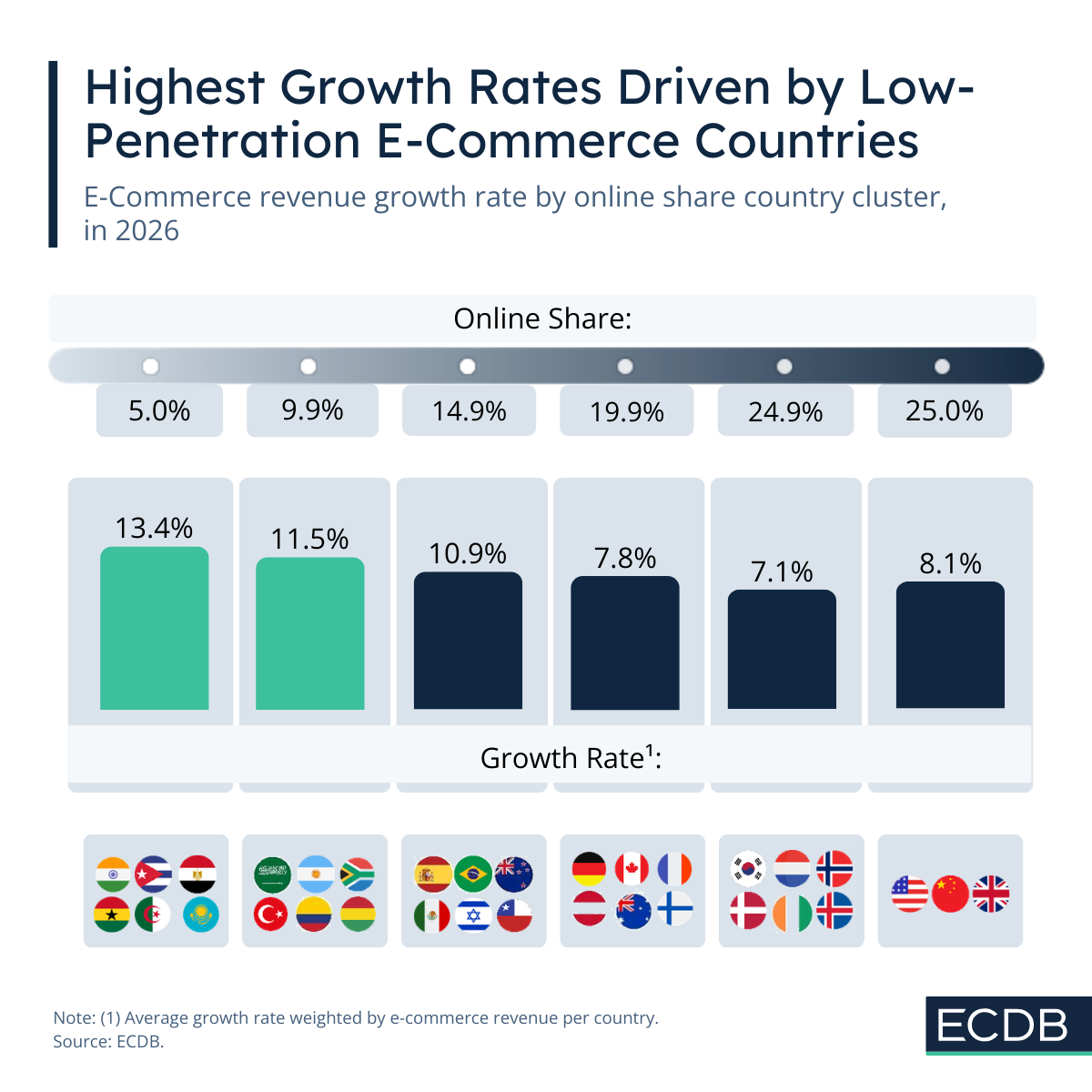
Mature markets often dominate headlines, but early-stage markets represent untapped potential. The data shows why they should not be overlooked.
Lower online penetration often correlates with higher growth rates. They create opportunities for retailers willing to enter early and build market share before competition intensifies.
It should not be forgotten that a low baseline of revenue favors high percentage growth. When markets start from a small volume of online sales, even modest absolute increases translate into high relative growth, which partially explains the rapid growth observed in early-stage markets.
The pattern discerned is the following:
Fastest Growth: Low-Penetration Markets
Markets with online penetration below 10.0% are seeing the fastest growth in online retail revenues. Examples include:
In these regions, e-commerce is just beginning to take off. Rising smartphone adoption, improving payment systems, and increasing internet access drive consumers online and create fertile ground for early movers. Reported growth rates in some of these markets have reached up to 13.4%. This rate reflects both the adoption curve and low starting volumes.
But the challenges of emerging markets reflect the very opportunities they present, such as underdeveloped infrastructure and limited digital payment adoption.
Slower Growth: Mature Markets
In contrast, mature markets such as South Korea, Netherlands, Ireland, and Switzerland, Germany, and Canada show slower e-commerce growth at around 8.0%.
In markets with already higher online shares, established retailers tend to dominate key segments and there is limited room for rapid development. But they do have advantages, including high consumer trust in online shopping and a solid willingness to spend on e-commerce goods.
Growth Surges in the Giants
Interestingly, growth rates rise again among the world’s largest markets: the US, UK, and China.
Sheer market size sustains momentum.
High digital adoption ensures continued online activity.
Innovation and leading platforms continue to drive expansion, from advanced logistics to social commerce.
Even in these highly developed markets, opportunities remain for players who can innovate and capture consumer attention.
Why Online Adoption Matters
Despite the statistical reality that low-adoption markets grow higher due to a lower revenue baseline, there is potential in low-adoption markets, which is due to their long-term expansion capacity.
As internet access improves, digital payments spread, and logistics networks develop, online retail can scale rapidly and reach entirely new consumer groups.