Amazon Market Concentration: Four in Five Dollars on Amazon Are Spent in Just Five Markets
Market concentration is a law of retail. On Amazon, this becomes particularly evident. Four in five dollars land in just five countries, the US on top.

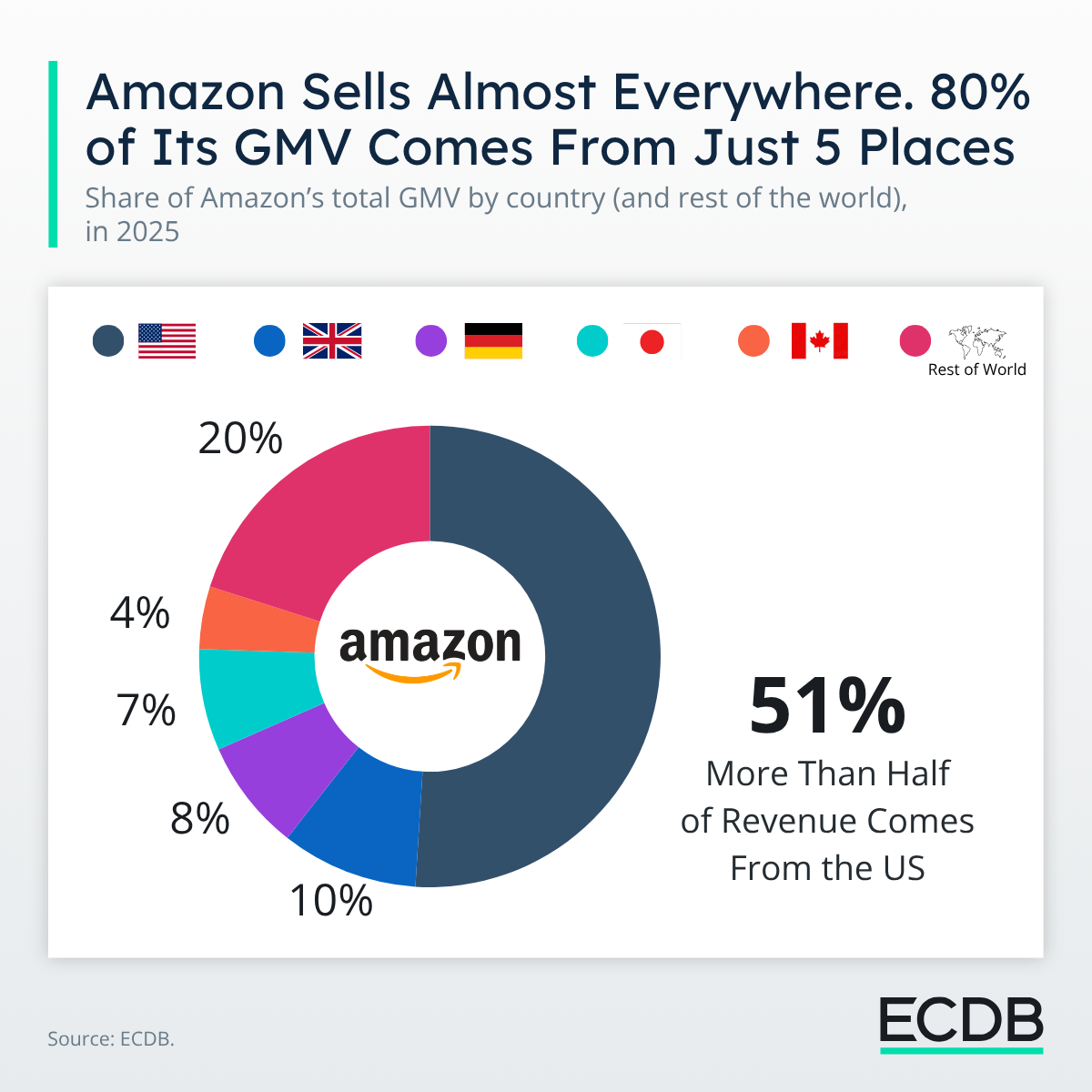
Amazon is the largest retailer in global e-commerce, but its footprint is far from even. Five markets generate 80% of its total GMV. Four out of every five dollars spent on Amazon flow through just these five countries.
The Core Five: USA, UK, Germany, Japan, Canada
The five core markets is where Amazon's advantage compounds.
51% of Amazon's GMV are generated in the US.
The UK follows further behind with 10%.
Germany is Amazon's third-most relevant market with 8%
Japan follows closely with 7%
Canada comes in fifth with 4% of Amazon's GMV
Even though these markets contribute smaller percentages to Amazon's overall sales, Amazon's role there is far from arbitrary.
The top five markets represent places where Amazon's logistics network is most developed, Prime membership is most entrenched and brand loyalty runs deep. This makes direct competition extremely difficult.
The "Amazonification" of markets is real, too, describing the phenomenon that consumer expectations change because of the fast delivery, vast product offering and service available at the plaform. The change in consumer expectations puts pressure on existing retailers and new entrants in the market and it is particularly prevalent where Amazon has a stronger foothold.
The Remaining Fifth: 20% Account For Rest of the World
80% of Amazon GMV is generated by five markets. The remaining 20% is spread across the rest of the world. This is where other providers take on more prominent roles, either because Amazon entered late, less aggressively, or not at all.
MercadoLibre holds Latin America, Trendyol leads in Türkiye, Allegro dominates in Poland and Shopee commands Southeast Asia.
That gap in Amazon's portfolio is where local and regional players have built real strongholds.
Wrap-Up: Amazon's Concentration Has Important Implications for Markets
Different groups will read this concentration differently. Local and regional retailers see a list of open battlegrounds: the 20% spread across Latin America, Türkiye, Poland, and Southeast Asia is where a challenger actually has a chance.
Brand owners face a different calculation. Selling into the core five means competing inside Amazon's most mature, most crowded marketplace, while selling into the remaining fifth means less traffic but far less competition too.
Amazonification arises where Amazon's presence is strongest, raising the bar for what consumers expect from e-commerce overall. That makes entry into Amazon's top five even harder, while the rest of the world still runs on more lenient conditions.

Related Articles
All ArticlesReady to Unlock the Full Power of ECDB?
Book a demo to see how ECDB's market intelligence can support your business.