Just Seven Countries Carry 86% of Amazon's Global GMV
Amazon generated US$847.4 billion in 2025, and 86% of this figure come from only seven markets. Outside that group, even within its own top 10, Amazon's lead already thins.
Three Years to the Top
Temu is the controversial retailer that inflamed world tariff discussions with a strategy build around low prices and wide product variety. It already ranks first in four European markets, and this climb is not over.

Nadine Koutsou-Wehling
Data Journalist
September 15, 2026
Retailers
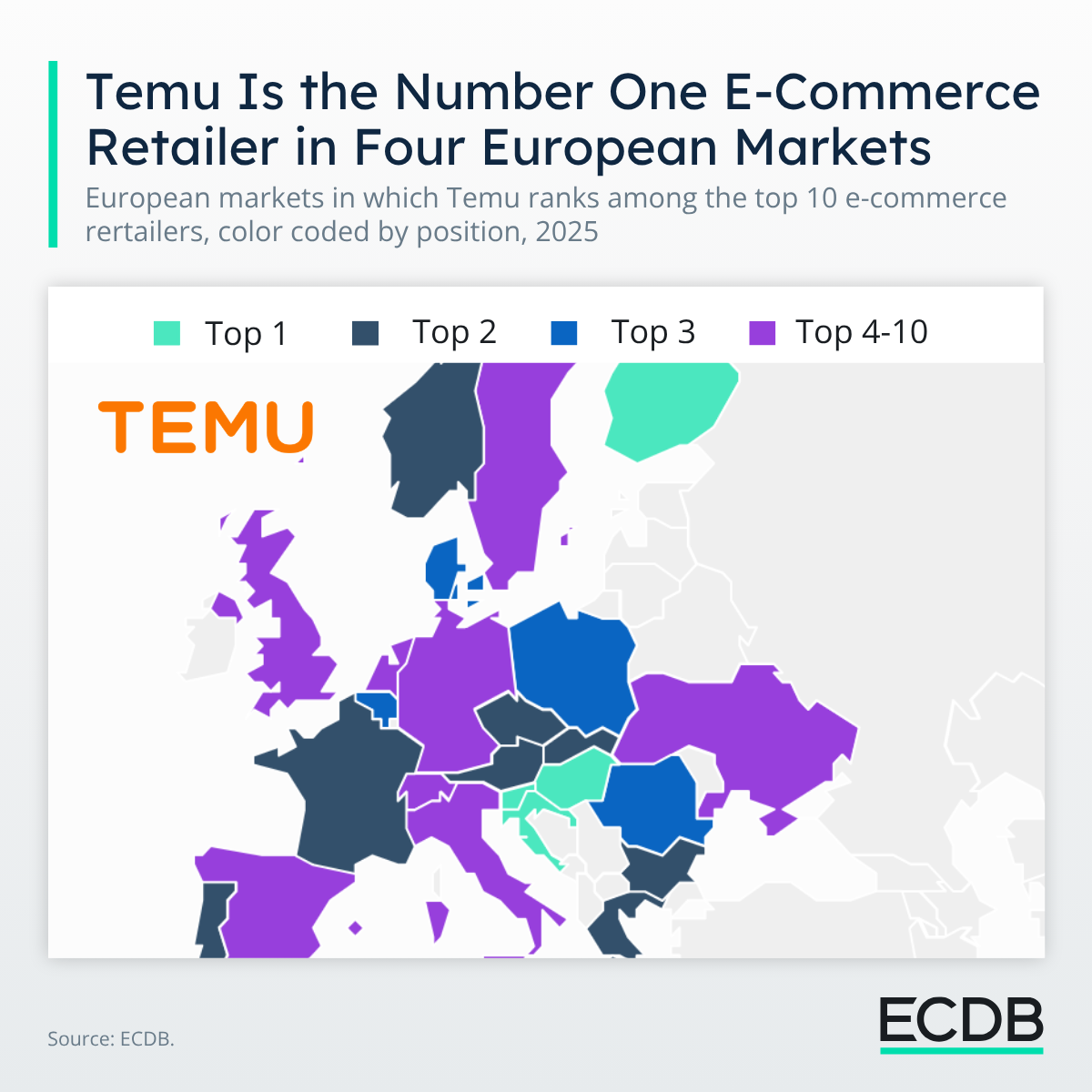
Three years after entering the region, and Temu is the number one retailer in four European markets.
Where Temu ranks in any given market depends on who it competes with. The strength of the domestic market determines how far Temu has to climb to reach the top spot.
In Finland, Croatia, Hungary and Slovenia, Temu is now the largest e-commerce retailer. It took the retailer only three years to get there.
These four share a structural trait. None of them has a domestic marketplace operating at the scale of a Bol.com or an Allegro, and none has a local Amazon storefront.
Shoppers in all four markets were already used to buying from foreign sites, which meant Temu had to compete with far less dometically entrenched players. However, even in markets where the domestic competition is strong, Temu climbs the ranks.
Temu sits second in France, Portugal, Norway, Bulgaria, Greece, Austria, Czechia and Slovakia. France stands out in that group as one of Western Europe's largest e-commerce markets.
The value proposition explains Temu's competitive edge. It undercuts established retailers on price and beats them on product variety. That combination pushed it into the top two in twelve European markets within three years.
Germany, Switzerland, the UK, the Netherlands, Italy and Spain all keep Temu out of the top two. Each has a settled hierarchy at the top of its e-commerce sector, built long before Temu arrived.
Switzerland makes the pattern clearest. Two homegrown electronics retailers, Galaxus and Digitec, hold the top two spots. Four more retailers stand between them and Temu
The UK and the Netherlands follow the same script, but with homegrown retailers continuing to hold the top position in the market
Italy and Spain add Amazon to the list of gatekeepers again.
A deep domestic retail sector raises the ceiling on how far a new entrant can climb, and these six markets have the deepest ones in Europe. Nonetheless, Temu managed to enter the top 10 ranking in each of these markets, which demonstrates its wide appeal across the continent.
Temu leads where the domestic sector never consolidated around a dominant platform. It places second where a single incumbent holds the top spot. But across Europe, its appeal is undeniable. Climbing into the top 10 ranking in the core of the continent within just three years is an astonishing feat, one that is won through competitive pricing and a wide product selection.
These are 2025 figures. Any tariff effects would only start showing up in next year's data, which makes the current rankings a useful baseline for measuring what changes next.

Related Articles
Amazon generated US$847.4 billion in 2025, and 86% of this figure come from only seven markets. Outside that group, even within its own top 10, Amazon's lead already thins.
Sephora is the biggest online beauty retailer by GMV, but that doesn't mean it wins on every other KPI. Here is why it still emerges on top.
Market concentration is a law of retail. On Amazon, this becomes particularly evident. Four in five dollars land in just five countries, the US on top.

Click here for
more relevant insights from
our partner Mastercard.
Book a demo to see how ECDB's market intelligence can support your business.