Just Seven Countries Carry 86% of Amazon's Global GMV
Amazon is a world-class retailer, but its GMV still centers around only a few markets. Its lead thins fast outside that group.

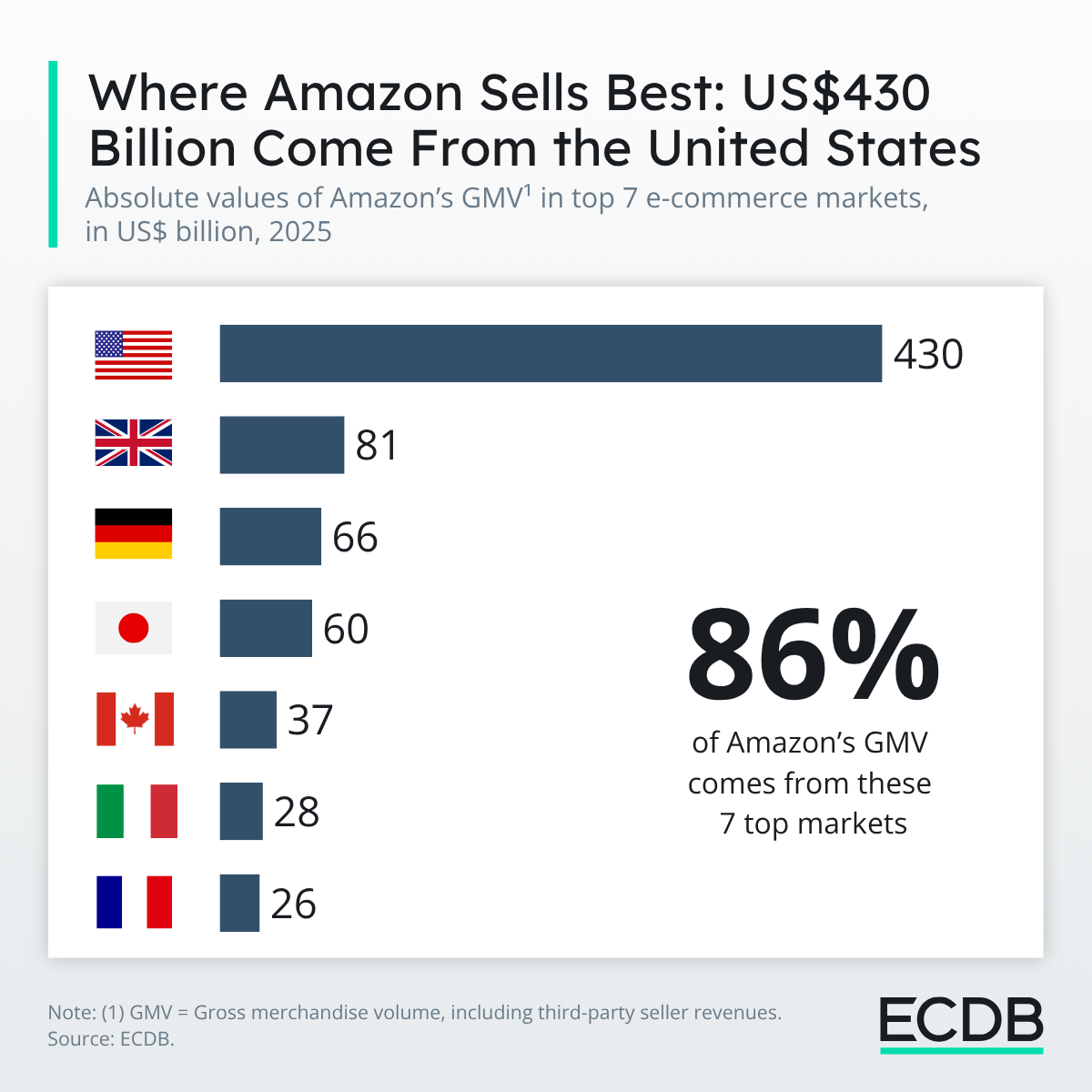
Amazon generated a total GMV of US$847.4 billion in 2025. That even surpasses the GDP of small but wealthy European economies like Belgium and Ireland. Despite its retail power, Amazon is still dependent on its top markets, where 86% of its GMV comes from.
Having recently reported about market concentration at Amazon, we now examine where Amazon's influence is biggest, and where it is being surpassed by other retailers.
Amazon's Global Business Runs Through Just Seven Countries
Worldwide, Amazon generated US$847.4 billion in GMV. Just seven of its markets carry 86% of that total, leaving the remaining 14% scattered across every other country where Amazon operates.
At the same time, Amazon dominates e-commerce in most countries where it operates. Even though every other country outside of the United States contributes comparatively small amounts to total GMV, Amazon's footprint is ubiquitous.
The top seven countries for Amazon are as follows:
The United States, with US$430 billion
The United Kingdom, US$81 billion
Germany, US$66 billion
Japan, US$60 billion
Canada, US$37 billion
Italy, US$28 billion
France, US$26 billion
The United States alone generates more than the other six markets combined.
The Top Seven Are Where Amazon's Advantage Compounds
Every one of those seven markets is also a G7 economy: the United States, the United Kingdom, Germany, Japan, Canada, Italy and France.
High incomes, wide credit card penetration and mature broadband infrastructure made online buying viable in this group well before it worked almost anywhere else. Amazon built its business exactly where that addressable market was already the largest.
Two decades of reinvestment compound the effect. Profit from these seven countries funds more warehouses, faster delivery windows and a deeper seller base in the same seven countries, so the gap over every other market keeps widening rather than closing.
Where Amazon's Grip Loosens: India, Brazil and the Long Tail
India, Brazil and Spain round out Amazon's top ten. Each still generates GMV in the double-digit billions. Beyond that top 10, Amazon's share of any single country's total retail sales gets small fast.
In India and Brazil, Amazon has already lost the lead. Flipkart generates more GMV than Amazon in India and MercadoLibre holds the equivalent position across most of Latin America, including Brazil.
Flipkart was built on a head start and on payment habits, cash on delivery among them. Walmart owns a majority stake in Flipkart since 2018, giving the local platform the capital to keep building logistics infrastructure of its own.
MercadoLibre is backed by its own payment arm, Mercado Pago, and its own delivery network, Mercado Envíos.
Both challengers launched years before Amazon committed seriously to their markets. That timing gap is what let Flipkart and MercadoLibre build the infrastructure their home markets needed before Amazon even arrived.
Amazon's Strength Skews West
A clear pattern is visible by geography. The United States, Canada, the United Kingdom, Germany, Italy and France are all North American or Western European. Japan is the single exception, and it is a market Amazon has treated like a home base since 2000.
Beyond that group, Amazon's position weakens the further it moves from Western Europe and North America. South Asia, Eastern Europe and Latin America are exactly where domestic platforms had years to build logistics, payments and customer habits before Amazon committed.
For a global brand, Amazon's commercial weight sits overwhelmingly in the West.
Wrap-Up: Amazon's Retailer Profile Reveals More
Beyond being a trusted source for e-commerce insights, ECDB provides real-time market data for e-commerce businesses. This encompasses annual and monthly revenues, market shares, cross-border splits, category insights, transaction KPIs and more.
Brands newly launching in a market can check Amazon's footprint there or who else calls the shots. Finding competitors and analyzing & comparing the results helps assess any retailer or market on a deeper level.
On top of that, for anyone interested in Amazon more deeply, you can now trace any given brand's performance on Amazon, including revenue by seller type and trends across 12 markets.

Related Articles
All ArticlesReady to Unlock the Full Power of ECDB?
Book a demo to see how ECDB's market intelligence can support your business.