Eastern Europe is known for its distinct market structure, where Amazon does not call the shots. Where a strong local champion is absent, though, cross-border competitors climb the rankings fast.
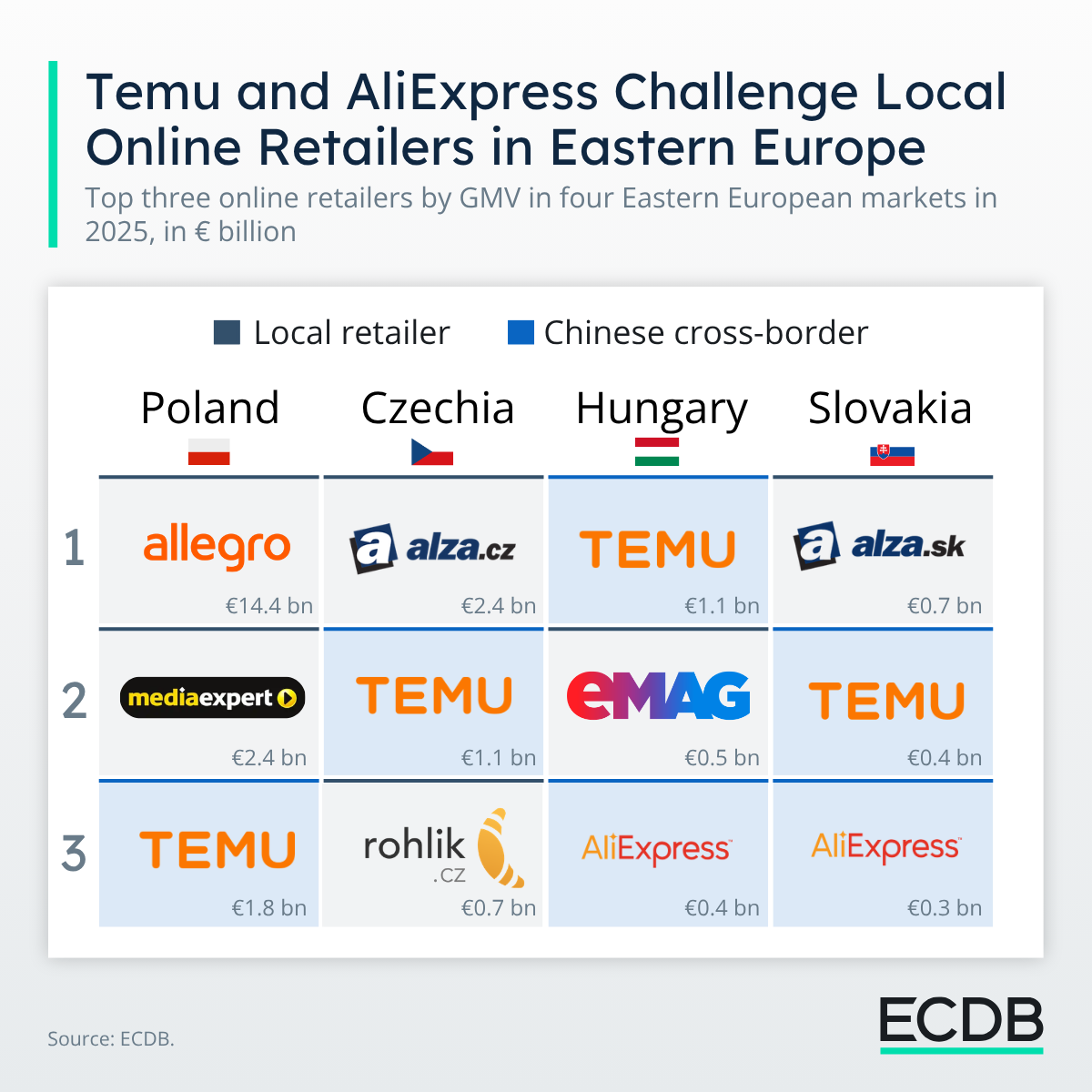
The case in point are these select four markets, where either there is a large retailer on top, or Temu and AliExpress have an easy time to reach the number one spot.
The Size of the Local Champion Decides How Far Temu Climbs
Poland shows what a real defense looks like. Allegro generates €14.4 billion, roughly eight times Temu's €1.8 billion in the same market. The platform launched in 1999, years before Amazon considered the region, and built a 3P marketplace model with a loyalty program that made it the default starting point for Polish online shoppers. Temu arrives into a market where the habit is already formed and paid for.
Czechia sits one tier down. Alza.cz reaches €2.4 billion on a population of roughly 10.5 million, which makes it dominant domestically while leaving it a fraction of Allegro's absolute size. Alza built its position on electronics retail with its own logistics network and pickup box infrastructure. That gives it a service advantage Temu cannot match on delivery speed, so it stays on the second spot.
Slovakia is where the argument gets thin. Alza.sk generates €655 million, which is less than Temu's entire Hungarian business. The Slovak operation is an export of the Czech one rather than a champion that grew from the market itself, and a lead that small is a lead that can disappear inside a single strong quarter for a competitor with acquisition budget to spend.
Hungary had no defender on that scale. Its leading domestic marketplace, Extreme Digital, was absorbed by eMAG in 2019, so the country's top platform answers to a foreign owner rather than a homegrown one. Hungarian shoppers never settled on a single default the way Polish and Czech shoppers did. Temu took the top spot at €1.1 billion.
Price Sensitivity Made the Region an Easy Target
Temu competes on price and gamified discovery. Sourcing its products directly from manufacturers, Temu removes the margin layers that domestic marketplaces carry. Its discount mechanics keep shoppers returning to browse rather than to buy something specific.
In markets where disposable income is lower than the European average, these price mechanics become even more of a competitive advantage. The incumbents built their lead on selection, delivery, and trust. But for someone who is optimizing on price alone, the cross-border challengers like Temu and AliExpress become indispensable.
Temu entered the European top 10 in considerably more markets than the four covered here. Our research shows that Temu's performance is best where the competition is within reach.
Wrap-Up: The Defense Holds Where It Is Big Enough
Regional marketplaces face an uneven picture depending on where they operate. Allegro has the size to absorb the pressure and the time to respond. Alza.sk has neither.
Brands selling into the region face a different calculation. A top-three marketplace that sources direct from manufacturers changes what a competitive price looks like in every category it touches, which affects margin expectations globally.
Eastern European marketplaces still hold the advantage where they are big enough to defend it, but that list is getting shorter.